Description
What the Televes Ellipse Mix is
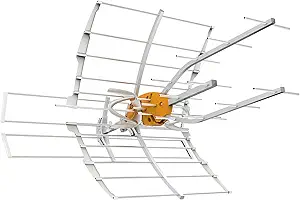
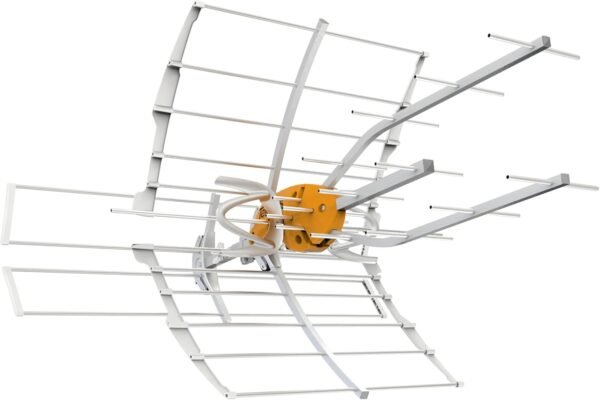
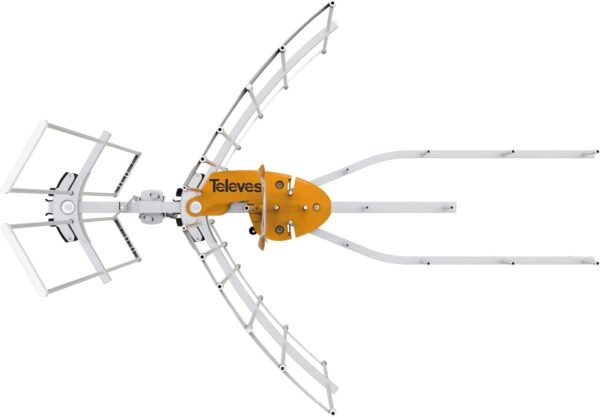
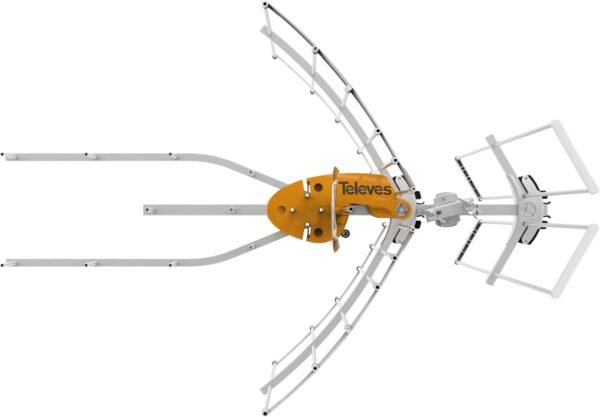
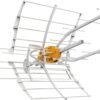
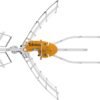
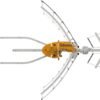
The Ellipse Mix is an outdoor television antenna designed for United States broadcast frequencies, in a compact triple boom form that can also go in an attic. It is directional, meaning it must be aimed at the transmitters, and it includes a built in preamplifier rather than requiring one to be bought separately. The impedance is 75 ohm, the model number is 148883, the color is orange and the weight is 9.58 pounds.
Televes builds the product around one idea: automatic gain control. The TForce preamplifier continuously measures the signals arriving at the antenna and adjusts its own amplification in real time, independently for the VHF and UHF bands. That matters because a fixed gain preamplifier has a single failure mode in both directions. Too little gain and weak stations do not come through; too much gain and a strong local transmitter overloads the front end and takes out everything else. An antenna that adjusts itself handles a location that has both, which is most locations.
A UL listed low consumption power supply is included, with two outputs so the signal can be distributed to a second television.
The mile range figure, plainly
The listing advertises up to 75 mile range. That number should be treated the way every antenna range figure should be treated, which is as a theoretical maximum under conditions almost nobody has.
Television broadcast at these frequencies travels essentially in a straight line. A 75 mile figure assumes an unobstructed path between the antenna and the transmitter, with nothing in between and both ends adequately elevated. It says nothing about a hill between you and the tower, a stand of trees, a neighboring building, the antenna’s height above ground, or the transmitter’s power and antenna pattern. Two houses on the same street can receive different sets of stations.
The right approach is to find out what is actually receivable at your address before buying any antenna. The FCC publishes a reception map tool that takes an address and reports predicted signal strength for each station, and several broadcaster and industry tools do the same. Those results tell you which stations are realistic, how strong they are, and what compass bearing they arrive from, which is the information that determines whether an antenna will work and where it should point. No mileage rating on a box can tell you any of that.
Channels 7 through 36, and why that matters
This is the single most important technical detail in the listing and it is easy to miss. Televes states the antenna is designed for reception of TV signals on RF channels 7 through 36. That covers high VHF and UHF. It does not cover low VHF, RF channels 2 through 6.
A small number of stations still broadcast on low VHF, and if one of the stations you want sits there, this antenna will not receive it. Checking this requires care, because the channel number displayed on screen is a virtual channel and is usually not the actual RF channel the station transmits on. After the broadcast repack many stations kept their old on screen number while moving to a different RF channel entirely. The coverage lookup tools report the real RF channel, and that is the number to compare against the 7 to 36 range.
The upper limit matters too. Filtering above 608 MHz is deliberate: the spectrum above that was reallocated to cellular use, and 5G transmitters in that band are a growing source of interference for television reception. Cutting them out is a genuine benefit, and it also means the antenna does not attempt to receive anything above RF channel 36 because there is no longer television there.
Installation and the amplifier
Televes claims assembly in under 60 seconds, which for an antenna is unusual and is a function of the compact triple boom design rather than a corner cut. The same compactness makes attic installation practical, though an attic install costs signal: roofing material, foil backed insulation and metal ductwork all attenuate the signal, and a marginal station received outdoors may be lost indoors.
The built in preamplifier needs power, which is why a power supply is included. It is inserted in the coaxial run indoors and sends voltage up the cable to the antenna. That means the antenna will not work if the power supply is omitted or if a splitter that blocks DC is installed between them.
FM filtering removes interference from broadcast radio, which sits just below the high VHF television band and is a common cause of overload in urban areas.
Highlights
- Covers RF channels 7 through 36, high VHF and UHF.
- Built in TForce preamplifier with automatic gain control, adjusted separately for VHF and UHF.
- Filters FM radio and LTE or 5G signals above 608 MHz.
- No separate preamplifier purchase needed.
- UL listed power supply included with two outputs for a second television.
- Compact triple boom design suitable for outdoor or attic mounting.
- Assembly stated at under 60 seconds.
- 75 ohm impedance, matching standard coaxial cable.
Things To Consider
- Does not cover low VHF, RF channels 2 through 6. Check the real RF channels for your local stations, not the on screen numbers.
- The 75 mile figure assumes unobstructed line of sight. Terrain, buildings and trees decide what a given address can actually receive.
- Use an address level coverage lookup before buying to establish which stations are realistic and what direction they come from.
- It is directional. It needs aiming, and stations in different directions may require a rotator or a compromise.
- Attic installation costs signal compared with a roof mount.
- The preamplifier needs its power supply in the coaxial run. A DC blocking splitter will stop it working.
- No mast, mounting hardware or coaxial cable is described in the listing.
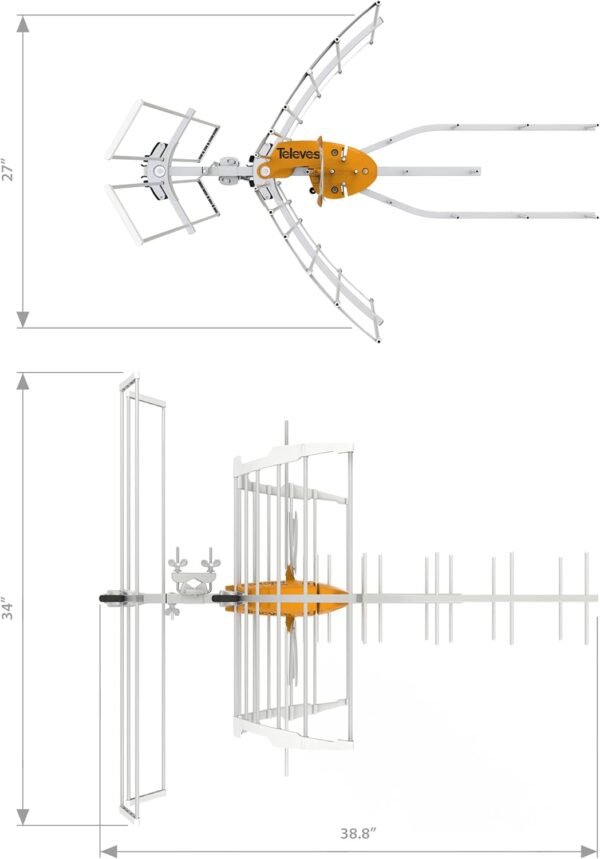
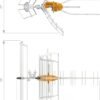
- Only package dimensions are published, not the assembled size.
Who it suits
This suits a household in a mid to long range reception area whose local stations sit on high VHF and UHF, who wants over the air television without a subscription and would rather buy one antenna with the amplifier built in than assemble a system. The automatic gain control genuinely solves the mixed strong and weak signal problem that catches out fixed gain setups.
It is the wrong antenna for anyone with an important station on low VHF, and it is more antenna than a household within a few miles of the transmitters needs. Those closer in should look at the indoor Winegard FL5500A, while anyone chasing UHF stations at long range should compare the Antennas Direct 91XG or the Winegard YA7000C in the TV antennas category. Licensed radio operators looking at a base station antenna instead should read the Tram 1481 in the radio antennas category.