Description
What the Tram 1481 is
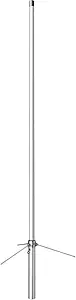
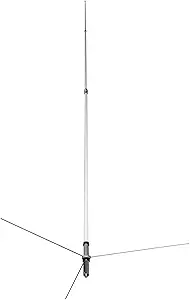
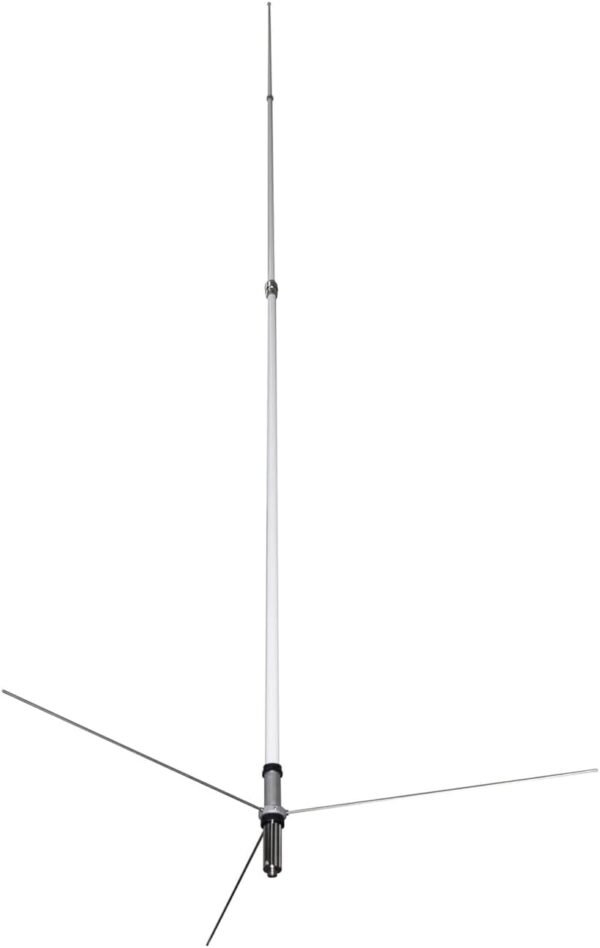
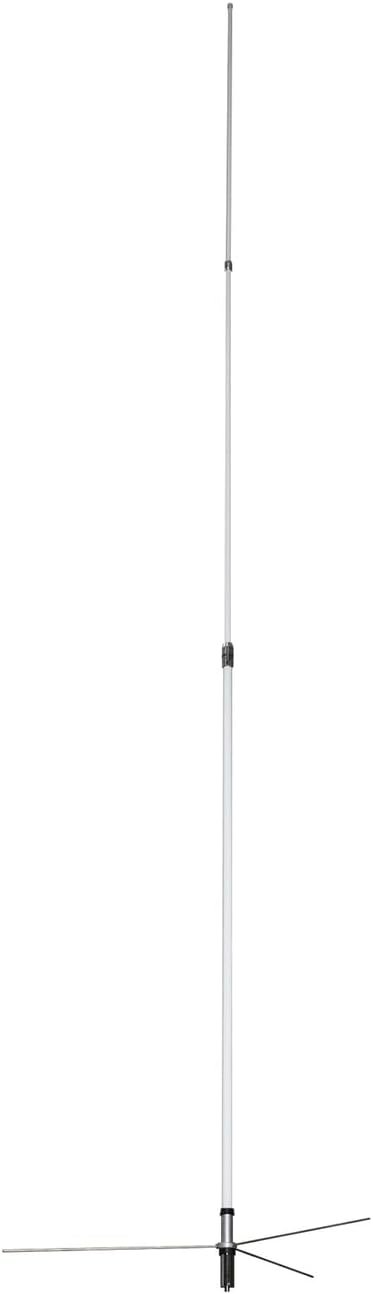
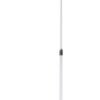
The Tram 1481 is a fixed base station antenna for two meter and seventy centimeter amateur radio. It is 17 feet tall, built in three fiberglass sections, finished in white, and terminates in a UHF SO-239 connector on a 50 ohm feed. It is not a television antenna and it is not a scanner accessory, although it will receive on those frequencies. It is a transmitting antenna for a licensed operator’s base station.
That distinction matters more than anything else in this listing. The frequency ranges Tram publishes, 144 to 148 MHz and 430 to 450 MHz, are the US amateur two meter and seventy centimeter allocations. In the United States, transmitting on those bands requires an amateur radio license issued by the FCC. Receiving is unrestricted. Anyone buying this antenna to transmit needs the license first, and this is the part the product listing never says.
Gain, bandwidth and what the numbers mean
Tram publishes real electrical figures for this antenna, which is more than most antenna listings manage. On two meters the antenna covers 144 to 148 MHz, a 4 MHz bandwidth, with 8.3 dBd of gain from a 5/8 wave three element design. On seventy centimeters it covers 430 to 450 MHz, a 20 MHz bandwidth, with 11.7 dBd of gain from an eight element c-load design. Ground plane radials measure 20.5 inches.
Gain figures are the most misunderstood number in antenna marketing, so it is worth being precise. Gain is not amplification. A passive antenna adds no power. What gain describes is the reshaping of the radiation pattern: a high gain vertical squashes energy that would otherwise go up into the sky down toward the horizon. On flat ground that helps considerably. On hilly terrain, or when working a repeater on a mountain above you, a high gain vertical can actually perform worse than a lower gain one because the useful signal arrives at an angle the pattern has suppressed.
Note also that these figures are quoted in dBd, gain relative to a dipole, not dBi, gain relative to an isotropic radiator. The two differ by 2.15 dB and manufacturers are not always consistent about which they use. Tram is explicit here, which is to its credit, but it makes the numbers look smaller than a competitor quoting dBi for the same performance.
Range, coverage and honest expectations
No mileage claim appears anywhere in this listing, and that is a point in its favor. Antenna range figures are the single most over claimed number in this category. What actually determines how far a VHF or UHF station reaches is height above surrounding terrain, what is between you and the other station, transmit power at both ends, and the sensitivity of the receiver on the other side. VHF and UHF propagation is essentially line of sight. An antenna at 17 feet on a rooftop behaves very differently from the same antenna at 17 feet in a valley.
The practical advice is the same one that applies to television antennas: work out what you can actually reach before buying hardware to reach it. For amateur use that means checking the repeater directories for your area and their published coverage maps, and talking to local operators about what works from your part of town. For over the air television, use an FCC or broadcaster coverage lookup for your address rather than a mile rating on a box. Nothing about a 200 watt power rating or an 11.7 dBd gain figure tells you what you will be able to work from your specific location.
Construction and mounting
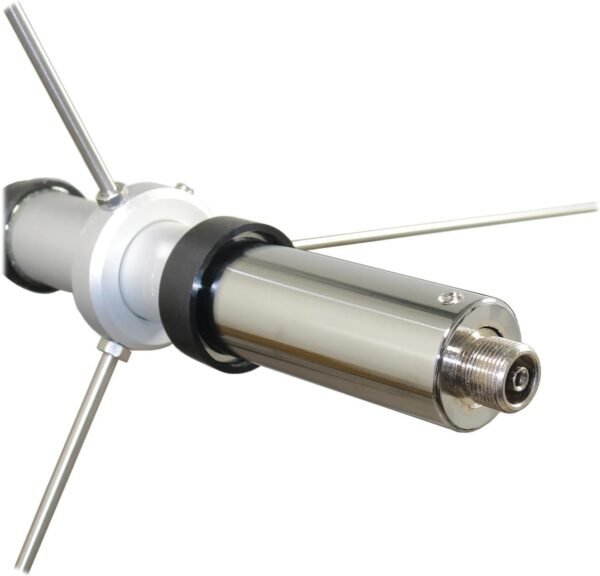
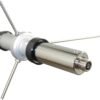
The radiator and coil are hermetically sealed inside the fiberglass tubing, which is the standard approach for keeping water out of a base antenna and keeping SWR stable across seasons. Tram states the joints between the three sections are designed so each maintains the strength of a single section antenna, and rates the assembly to a maximum wind speed of 90 MPH. That is a structural rating for the antenna itself and says nothing about the mast, the bracket or the building it is attached to, which are usually the weak points in a real installation.
The design is DC grounded. In practice that means the radiating element has a DC path to ground, which bleeds off static charge that would otherwise build up on the antenna and raise the receiver noise floor. Tram describes this as providing maximum lightning protection, and that phrasing overstates it. DC grounding helps with static dissipation. It is not a substitute for a proper lightning protection system with a bonded ground rod and a coaxial surge arrestor, and no one should install a 17 foot conductor above a building on the assumption that the antenna alone is handling the problem.
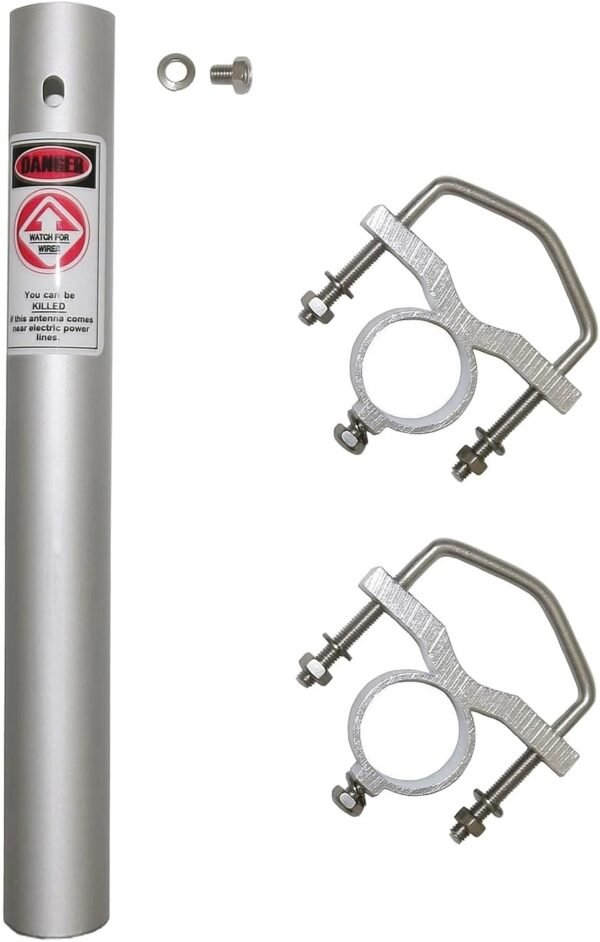
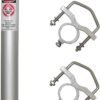
The supplied mounting bracket accepts mast diameters from 1 and 3/16 inches to 2 and 7/16 inches and includes three stainless steel radials. The connector is a UHF SO-239, so the feedline needs a PL-259 on the antenna end.
Highlights
- 17 feet tall in three fiberglass sections, rated to 200 watts.
- 144 to 148 MHz with 8.3 dBd gain, 430 to 450 MHz with 11.7 dBd gain.
- 50 ohm feed with a UHF SO-239 connector.
- Radiator and coil hermetically sealed in fiberglass tubing for weather resistance.
- DC grounded construction for static dissipation.
- Rated for wind speeds up to 90 MPH.
- Mounting bracket included, accepting masts from 1 and 3/16 to 2 and 7/16 inches, with three stainless steel radials.
Things To Consider
- Transmitting on 144 to 148 MHz or 430 to 450 MHz in the United States requires an FCC amateur radio license. The listing does not mention this.
- Seventeen feet of antenna needs a mast, a bracket and a plan. This is a permanent installation, not something to lean against a wall.
- Gain reshapes the radiation pattern, it does not add power, and high gain can hurt on hilly terrain or with a repeater above you.
- Gain is quoted in dBd, not dBi. Comparisons with other antennas need to use the same reference.
- DC grounding is not lightning protection. A real installation needs a bonded ground and a surge arrestor.
- The 90 MPH wind rating applies to the antenna. Your mast and mounting hardware are a separate question.
- Coaxial cable is not included, and 17 feet of antenna usually means a long run of feedline, where loss at 440 MHz becomes significant.
- The 200 watt rating is a maximum. It says nothing about how far a signal will carry.
Who it suits
This antenna suits a licensed amateur setting up or upgrading a home base station on two meters and seventy centimeters, with somewhere solid to mount 17 feet of fiberglass and a clear view toward the repeaters they want to work. The published gain and bandwidth figures are specific enough to plan around, the sealed construction is the right approach for a permanent outdoor install, and the included bracket covers most common mast sizes.
It is not for someone who wants better over the air television reception, who should look at the TV antennas category and specifically at the Televes Ellipse Mix or the Antennas Direct 91XG. It is also not for mobile use, where a mirror or magnet mount such as the Stryker SR-A10 or the Comet CA-2X4SRNMO is the correct answer. Operators comparing base antennas should also read the Diamond X30A review, and browse the wider radio antennas category.