
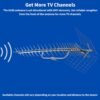
Description
Antennas Direct 91XG Yagi Outdoor UHF Antenna: what it is
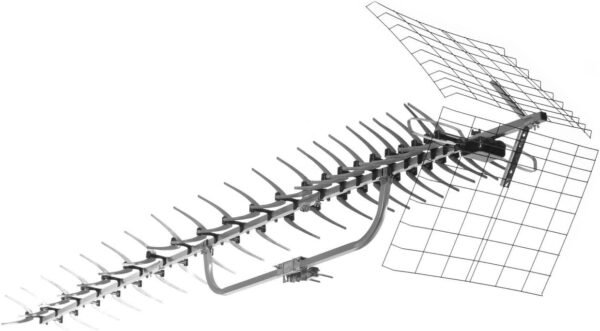
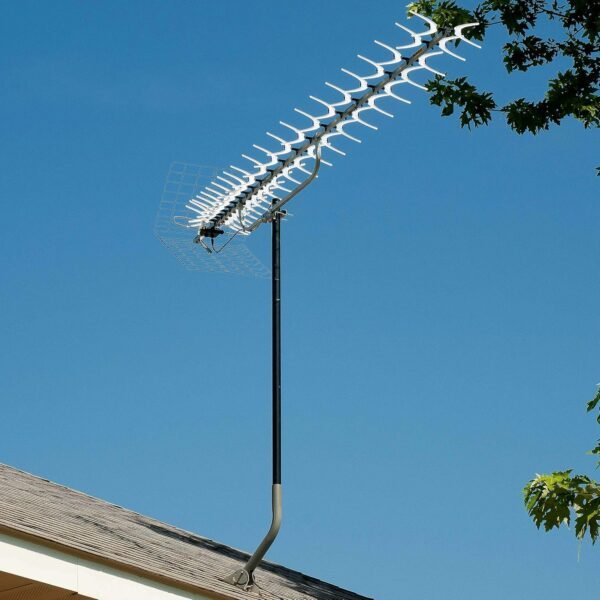
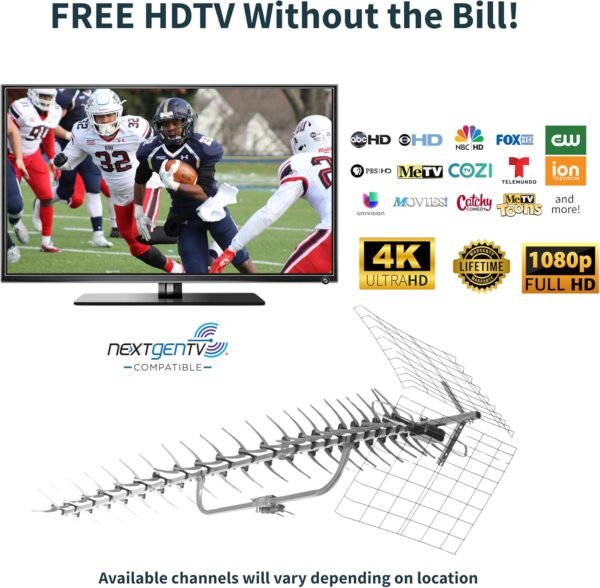
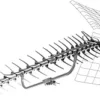
The 91XG is a uni-directional Yagi style outdoor television antenna from Antennas Direct, and it has been on the market since 2007. The manufacturer publishes an unusually complete specification, which is rare in this category and worth reproducing: a UHF frequency range of 470 to 608 MHz, peak gain of 17.4 dBi, a 24 degree horizontal beam angle, antenna dimensions of 22 inches high by 24 inches wide by 93 inches deep, a weight of 4 pounds, attic or outdoor mounting, all weather mounting hardware with an adjustable mast clamp, and a lifetime manufacturer warranty. Coaxial cable and mast are sold separately. The product title also states compatibility with 4K, 8K and NEXTGEN TV broadcasts.
NEXTGEN TV, also known as ATSC 3.0, needs a matching tuner inside the television as well as a suitable antenna, and support varies from set to set across models like the Hisense 55A6HX and the rest of the LED and LCD TVs category.
About that mileage figure, plainly
The listing advertises a range of 70 or more miles, and this is the single most misunderstood number in the whole antenna category, so it gets addressed before anything else.
An advertised mile range assumes unobstructed line of sight between the antenna and the transmitter. It is a laboratory style figure derived from the antenna’s gain, not a promise about any particular address. Broadcast television travels in more or less a straight line at these frequencies. A hill, a ridge, a stand of mature trees, a neighboring apartment block, a metal roof or simply the curvature of the earth between you and the tower will take a station away regardless of how much gain the antenna has. Two houses on the same street can get different results depending on which way the living room faces and what is in the yard.
The honest way to buy an antenna is therefore to look up your own address before you order. Antennas Direct publishes a tower locator on its own website and a free Antenna Point application for Android and iOS, and the FCC operates a public reception map for the United States. Those tools will tell you which stations broadcast toward your location, on which real channel, and from which compass bearing. That information decides whether this antenna is the right one far more than the mileage figure does.
The UHF only limitation, which matters more than the range
This is the most important technical fact about the 91XG and it is easy to miss. The published frequency range is UHF 470 to 608 MHz only. It does not cover the VHF bands.
Plenty of American television stations, including major network affiliates in many markets, broadcast on VHF real channels rather than UHF ones. The virtual channel number shown on screen is not the real broadcast channel, so a station that displays as channel 7 may be transmitting anywhere in the spectrum. If a station you want is on VHF, this antenna will not receive it, and no amount of aiming or amplification will change that. Check the real channel numbers for your market in the lookup tools before ordering, and if VHF stations are on the list, a combination antenna such as the Televes Ellipse Mix or the Winegard YA7000C is the more appropriate design.
Directionality and aiming
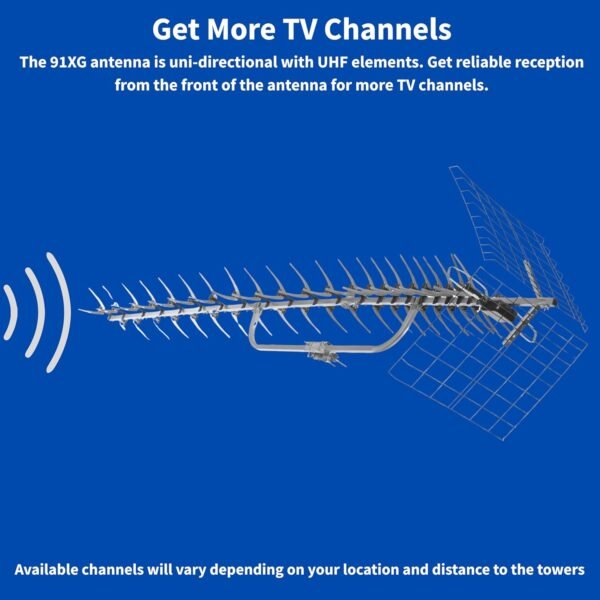
The 24 degree horizontal beam angle is the defining characteristic of this design. It means the antenna is extremely sensitive in one narrow direction and largely deaf everywhere else. That is a genuine advantage where all the transmitters sit in one general direction, because rejecting signal from other directions also rejects the reflections and interference that cause pixelation and dropouts. Antennas Direct states this outright in its own description.
It is a disadvantage where transmitters are scattered around the compass, because aiming at one group means losing another. Households in that situation either need a rotator, a second antenna, or a wider pattern design. A 24 degree beam also demands careful aiming. Getting it a few degrees off will cost signal that no amplifier will recover.
Highlights
- Published peak gain of 17.4 dBi, one of the higher figures available in a consumer UHF antenna.
- Narrow 24 degree horizontal beam angle for rejecting interference and multipath reflections.
- Rated for attic or outdoor mounting, with all weather hardware and an adjustable mast clamp included.
- Only 4 pounds, so mast loading and wind load are modest for its size.
- Snap-lock assembly, which reduces the number of loose fasteners during a roof installation.
- Lifetime manufacturer warranty stated in the listing.
- 406 customer ratings on record averaging 4.3 stars, on a product that has been sold since 2007.
Things To Consider
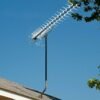
Size is the first practical issue. This antenna is 93 inches deep. That is nearly eight feet of boom projecting from the mast, which is a serious object on a roof and a genuine problem in many attics. Measure the attic run before assuming an indoor installation is possible.
Coaxial cable and mast are not included. Antennas Direct points out, reasonably, that a house previously wired for cable or satellite may already have usable coaxial runs in the walls. Check what is there before buying cable.
Neither an amplifier nor a preamplifier is included, and adding one is not automatically an improvement. An amplifier raises noise along with signal, and on a strong signal it can overload the tuner and make reception worse. Amplification helps with long cable runs and multiple television splits, not with a weak signal at the antenna.
Finally, reception is not a permanent state. Foliage in summer, weather, new construction and changes to a station’s transmitter power or location all move the line. An antenna that works today can lose a channel next year through nothing you did.
Who should buy it, and who should not
This suits a rural or outer suburban household that has checked its address, found the stations it wants clustered in one direction, confirmed those stations are broadcasting on UHF, and has a roof or mast where an eight foot boom can be mounted and aimed properly. In that situation the high gain and narrow beam are exactly the right tools.
Skip it if any station you care about is on VHF, since this antenna cannot receive those bands at all. Skip it if the transmitters in your market are spread around the compass. Skip it if the installation would have to be indoors in a small attic or an apartment, where a compact indoor design like the Winegard FL5500A is the realistic option even though it will receive less. The full range sits in the TV antennas category.

