

Description
What the Winegard YA7000C Is and Who It Suits
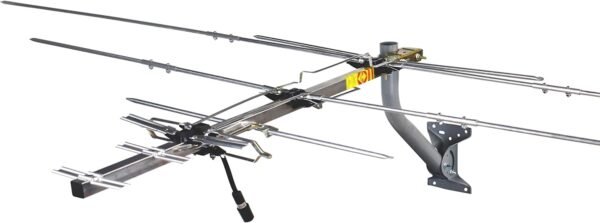
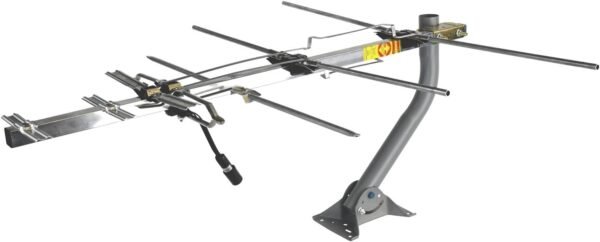
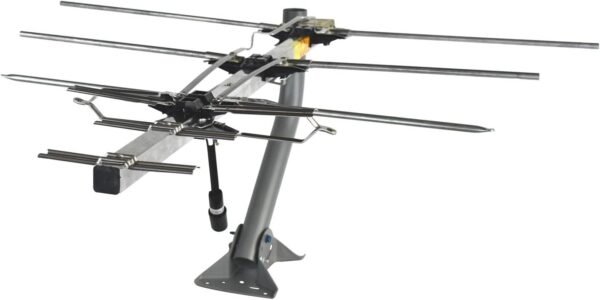
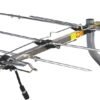
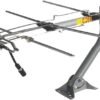
The Winegard YA7000C is an outdoor directional television antenna of the Yagi type, from Winegard’s Classic Yagi series. A Yagi is the familiar arrangement of a driven element with a reflector behind it and a row of directors in front, and it is a directional design: it collects signal strongly from the direction it points and rejects signal from behind. That directionality is the reason to choose one over a flat indoor panel.
Coverage is unusually complete for a compact antenna. Winegard specifies low VHF channels 2 through 6, high VHF channels 7 through 13, and UHF channels 14 through 50, with added extensions for the low band VHF elements. Low VHF coverage matters because some markets still carry major network affiliates on those channels, and most modern compact antennas handle them poorly or not at all.
The listing records a weight of 5.49 pounds, dimensions of 37 by 34.5 by 19 inches, an impedance of 75 ohms and a universal mount included in the kit. The record shows 338 customer ratings averaging 4.2 stars at the time this data was captured and a first availability date of September 18, 2019.
About the 70 Mile Range Claim
This is the number that sells antennas and it is the number that deserves the most skepticism, so it gets its own section rather than a footnote.
Winegard states a 70 mile range and says the antenna “can extend beyond the range of other antennas.” Any mile figure quoted for a television antenna describes a best case: clear line of sight to the transmitter, no terrain between you and it, no buildings, no dense foliage. Television signals at VHF and UHF travel in essentially straight lines and are blocked by hills and structures. A house on the far side of a ridge from the transmitter may receive nothing at 15 miles, while a house on a hilltop may receive well beyond the advertised figure.
The practical step before buying any antenna is to check a broadcast coverage lookup for your specific address. The Federal Communications Commission publishes a DTV reception map, and several broadcaster supported tools will take a street address and return the stations, the compass direction of each transmitter and the predicted signal strength. That tells you three things a mile figure cannot: whether the stations you want are reachable at all, which direction to aim a directional antenna like this one, and whether the stations you want are on VHF or UHF. Doing that first turns an antenna purchase from a gamble into a decision.
Anyone whose lookup suggests marginal reception should also read the higher gain Antennas Direct 91XG, which is a UHF only design with more elements, and compare it against this antenna’s broader band coverage.
Design and Installation
Construction
Winegard describes classic antenna construction that reduces antenna size and wind load while increasing element strength. Wind load matters more than buyers expect on an outdoor antenna: a large antenna on a mast is a lever arm, and wind is what eventually bends elements or loosens mounts. A compact design with fewer, stronger elements is a deliberate tradeoff of maximum gain against survivability.
Setup
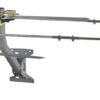
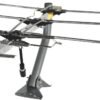
The elements fold and lock, with added extensions for the low band VHF section, and the kit includes a universal antenna mount. Including the mount is genuinely useful, since mount compatibility is where many antenna purchases go wrong and mounts are often sold separately, as they are with the amateur radio antennas covered in the TV antenna category.
Aiming
A directional antenna has to be aimed. The increased front to back ratio Winegard cites means the antenna rejects signals from behind more strongly, which reduces multipath interference from reflections, and it also means that pointing it wrongly costs you far more than it would with a multi directional antenna. Use the transmitter bearings from a coverage lookup, aim, then run a channel scan on the television. If different stations sit in different directions, you either compromise the aim or use a rotator.
Highlights
- Full band coverage: low VHF 2 to 6, high VHF 7 to 13 and UHF 14 to 50.
- Low band VHF extensions included, which most compact antennas omit entirely.
- Directional Yagi design with an increased front to back ratio for multipath rejection.
- Universal antenna mount included in the kit.
- Fold and lock elements for simpler assembly.
- Compact construction that reduces wind load on the mast.
- Standard 75 ohm impedance, matching normal coaxial cable and tuners.
- Light at 5.49 pounds, which keeps mast loading modest.
Things To Consider
- The 70 mile figure is a best case, not a prediction. Terrain and buildings determine what you actually receive. Check a coverage lookup for your address.
- The specification field says “Power Source Type: Corded Electric.” That is wrong. This is a passive antenna with no amplifier described anywhere in the listing, and it requires no power. The field appears to be contaminated data.
- No gain figures are published for any band. Winegard describes a uniform gain curve without giving numbers, and gain in decibels is the specification that would let you compare this against other antennas.
- No mast is included, only the mount. A mast, coaxial cable and grounding hardware are all separate purchases.
- This is an outdoor antenna. Installation involves working at height, and the feedline entry needs proper grounding for lightning protection. That is a job with real safety implications.
- It has to be aimed, and stations in different directions are a genuine problem for any directional antenna.
- UHF coverage is stated as channels 14 to 50, which reflects the current allocation after the broadcast spectrum repack. That is correct for present use and worth knowing if you are comparing against older antennas quoting channel 69.
- Run a channel scan after installation and repeat it periodically, since allocations change.
Who Should Buy It and Who Should Skip It
Buy the YA7000C if a coverage lookup shows your stations are reachable, if some of them are on VHF, and if you can mount an antenna outdoors. Full band coverage including low VHF with the mount included is a practical package, and the compact construction is a sensible tradeoff for a rooftop or attic installation that has to survive weather.
Skip it if you cannot install outdoors, where an amplified indoor antenna such as the Winegard FL5500A FlatWave Amped is the realistic option, or if all your stations are on UHF and you need maximum gain in one direction. Buyers planning a wall mounted installation alongside a television should also read the Mounting Dream MD2296, and the Televes Ellipse is worth comparing as an alternative outdoor design.

