Description
Robot Coupe J100 Centrifugal Juicer: what it is
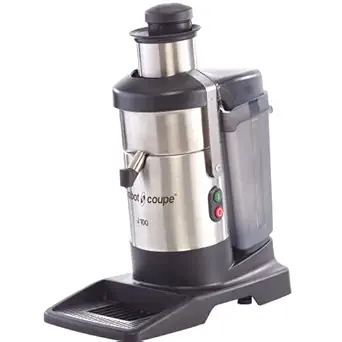
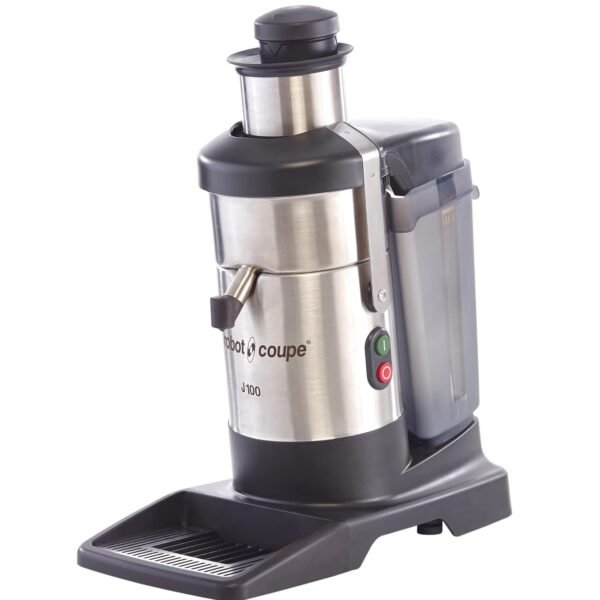
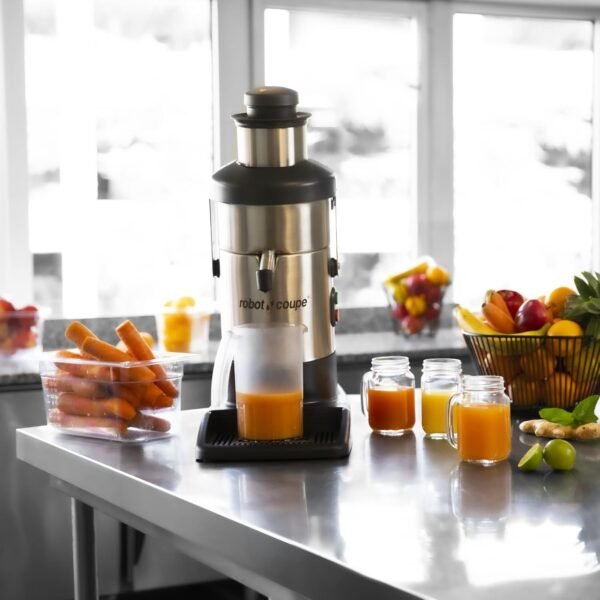
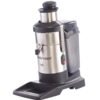
The J100 is a commercial centrifugal juicer and juice extractor from Robot Coupe, the French manufacturer of professional kitchen preparation equipment. The listing records dimensions of 21 by 9.25 by 23.5 inches, a weight of 39.73 pounds, France as the country of origin, and a first listed date of October 2020.
That is essentially the entire record. The manufacturer description field is empty, there is no motor specification, no capacity, no voltage, no feed tube size and no customer rating data. The customer reviews field contains a sales rank string rather than a rating, which is a data fault rather than a product characteristic. Nothing beyond the dimensions, the weight, the origin and the model designation can be sourced from this listing, and nothing is invented here to fill the gap.
The 39.73 pound weight is the most informative figure available. It tells you this is built around a substantial motor and a metal body rather than the plastic housings of domestic machines, and it tells you the machine stays where it is put rather than walking across a counter under load.
What a commercial centrifugal juicer is for
A centrifugal juicer grates produce against a fast spinning disc and flings the resulting pulp against a mesh basket, where the juice is separated by centrifugal force. It is quick, it handles hard produce like apples, carrots and beets well, and it is poor with leafy greens, which tend to pass through without being properly broken down.
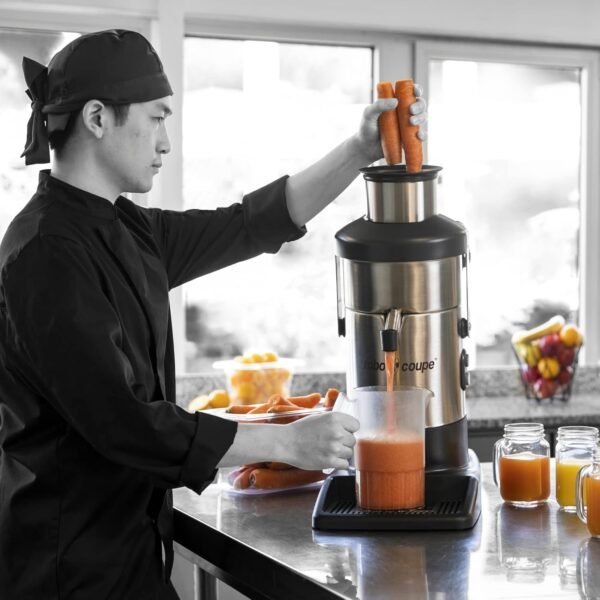
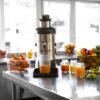
The professional distinction is continuous operation. A domestic centrifugal machine holds pulp inside the basket, which fills within a few minutes of hard use and requires stripping and rinsing. A commercial machine ejects pulp continuously into an external container so that service does not stop. That is the difference between a juicer that makes two glasses and one that runs through a breakfast rush.
Anyone weighing this against a slow juicer should understand they are different machines rather than better and worse versions of the same thing. A cold press machine such as the Kuvings AUTO10 crushes slowly with an auger, handles greens properly, and produces juice that separates less and keeps longer. It is also far slower per glass. Speed against yield and shelf life is the real decision.
How it relates to the J80
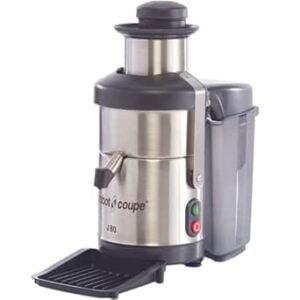
Robot Coupe sells a closely related model, the J80 Ultra, which also appears in this catalog. Both are commercial centrifugal juicers from the same maker with automatic pulp handling, and the listing data for both is similarly thin. The most visible difference in the records is size and mass: the J100 is listed at 39.73 pounds against 16 pounds for the J80, and it stands 23.5 inches tall against 19.75 inches. Anyone choosing between them needs Robot Coupe’s own specification sheets, which publish the motor rating, the feed tube diameter and the throughput figures that these listings do not.
Height, clearance and the feed chute
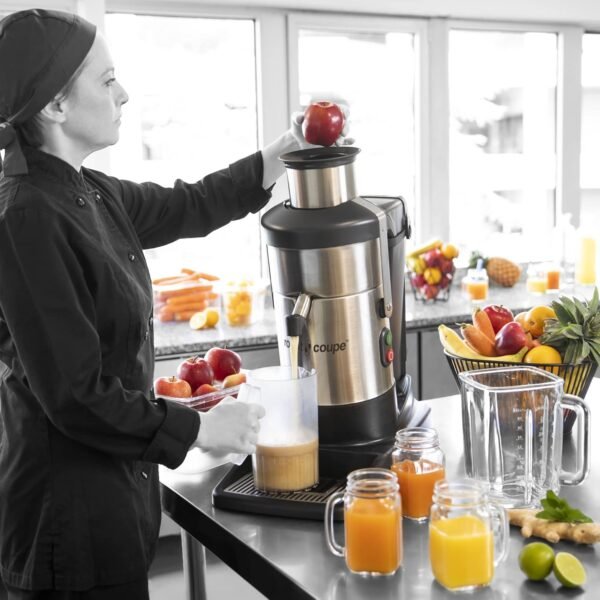
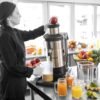
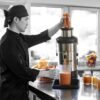
The 23.5 inch height is the dimension most likely to cause a problem on installation, and it needs adding to rather than taken at face value. Produce goes into a chute at the top of a centrifugal juicer, which means the space above the machine has to accommodate a hand holding an apple as well as the machine itself. Several inches of headroom above the stated height are required in practice, and a unit installed under a wall cabinet or a shelf will be unusable even if it technically fits.
The narrow 9.25 inch width is the corresponding advantage. Behind a bar or on a prep line, frontage is the scarce resource and depth usually is not, so a machine that is narrow and deep occupies less of the counter that matters. It also means the operator works at a compact station rather than reaching across a wide appliance, which is safer around a fast spinning disc.
Highlights
- Commercial grade centrifugal juicer designed for continuous service rather than domestic batches.
- Automatic pulp handling, so juicing does not stop to empty a basket.
- 39.73 pounds, which indicates a substantial motor and a stable machine under load.
- Made in France by a manufacturer with an established commercial service network.
- Narrow 9.25 inch width, useful behind a bar or on a prep line where depth is available and width is not.
Things To Consider
The absence of a specification is the dominant concern. A commercial kitchen cannot install equipment without knowing its electrical requirement, and this listing publishes no voltage, no amperage and no motor rating. That has to come from Robot Coupe or the dealer before an order is placed, along with the throughput figure that determines whether the machine suits the service volume.
There is no rating data at all, so there is no independent feedback to weigh. That is normal for commercial equipment sold through dealers and it is a real disadvantage for a private buyer with no service relationship.
Cleaning is the daily cost of any juicer, and commercial machines have more parts. A mesh basket and grating disc left dirty become a food safety issue rather than an inconvenience. Establish which parts strip out without tools and which are dishwasher safe.
Noise is worth asking about. Centrifugal juicers run their discs at high speed and are loud by nature, which matters in a small cafe where the machine sits near customers.
Finally, at nearly 40 pounds and 23.5 inches tall, this needs a permanent home with clearance above for the feed chute. It is not an appliance that gets put away.
Who should buy it, and who should not
This is for a juice bar, a cafe, a hotel breakfast service, a supermarket or a catering kitchen that juices in volume and needs equipment that will not stop mid service. The build weight and the Robot Coupe name are the arguments for it, and the dealer specification sheet is where the actual decision should be made.
It is the wrong purchase for a home kitchen by a wide margin. It costs far more than a domestic juicer, occupies permanent counter space, and offers a continuous duty capability that a household will never use. Home buyers should look at the centrifugal juicers category for speed, or the Omega J8006 masticating juicer for yield and greens performance. Anyone juicing only citrus should look at a dedicated press such as the Dash Dual Citrus Juicer, which does that one job far better than any centrifugal machine.