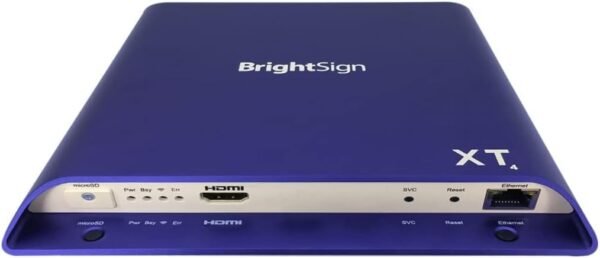
Description
BrightSign XT244 Standard I/O 4K Player: what it is
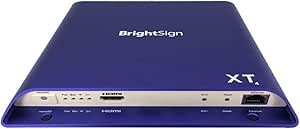
The XT244 is a digital signage media player from BrightSign, first listed in July 2018. It is not a consumer streaming box. BrightSign builds hardware for commercial signage networks, the kind of screens found in airports, retail stores, quick service restaurants, corporate lobbies, hospitals and stadium concourses, and the XT244 sits in the upper half of that range. The manufacturer description states the specification directly: true 4K, dual video decode, an enterprise HTML5 player with the standard input and output package, and Power over Ethernet Plus. The product title adds Dolby Vision support. The attribute table records a weight of 1 pound and product dimensions of 11.33 by 9.68 by 2.83 inches, which is the shipping package rather than the unit.
Anyone who arrived here looking for a device to put Netflix on a living room television is in the wrong place, and should be looking at consumer options in the streaming media players category such as the Roku streaming player. The XT244 is a different kind of product with a different job.
What a signage player actually does
The difference between a signage player and a consumer streaming stick is not raw performance. It is behavior. A signage player is built to power on by itself after a power cut and resume the correct content without anyone touching it, to run continuously for years rather than for evenings, to be managed remotely across a fleet of hundreds of screens, and to display exactly what it was told to display with no home screen, no advertising tiles and no recommendation engine.
The dual video decode capability named in the description is a good example of what that buys. It allows two video streams to be decoded simultaneously, which is what a layout with a main video area plus a secondary video window needs. Consumer devices generally cannot do this, because consumers never ask for it.
Enterprise HTML5 is the other half. Signage content is frequently a web page rather than a video file: a live departures board, a menu that updates from a database, a dashboard, a queue display. Running a robust HTML5 engine locally is what makes that possible without a separate computer behind every screen.
Power over Ethernet Plus
PoE Plus is the feature that most changes an installation’s cost. It carries both data and power over a single Ethernet cable, which means a player mounted behind a ceiling hung screen or inside a display enclosure needs one cable rather than a cable plus a mains outlet. Anyone who has priced an electrician to add power at ceiling height understands why this matters. It also means the whole player fleet can be power cycled centrally from the network switch.
Video capability
True 4K resolution and Dolby Vision support are both named. On a signage player, 4K matters for large format screens and for video walls where content is cropped from a larger canvas, and for fine text on a menu board viewed close up. Dolby Vision is more unusual in this context and points at higher end applications such as showrooms and cinema lobbies where content quality is the point of the installation.
What the listing does not publish is the supported codec list, the maximum frame rate, the exact port complement of the standard input and output package, the storage medium or the memory. Those are all published by BrightSign in its own datasheets, and anyone specifying a deployment should work from those rather than from the retail listing, which is thin by commercial standards.
Highlights
- True 4K output with Dolby Vision support named in the product title.
- Dual video decode for layouts that need two simultaneous video regions.
- Enterprise HTML5 engine for web driven signage content.
- Power over Ethernet Plus, so a single cable can carry both data and power to the player.
- Purpose built for continuous unattended operation and remote fleet management.
- One pound and small enough to mount behind a display.
Things To Consider
The customer feedback base is five ratings. The 4.8 star average sounds impressive and means very little at that sample size. This is a professional product bought through integrators rather than by individuals, so a thin retail rating history is expected rather than alarming, but it does mean there is no crowd verdict to lean on. Evaluate it on BrightSign’s datasheet and on the integrator’s experience.
There is no consumer content ecosystem here. No app store, no Netflix, no YouTube app in the sense a home user expects. Content is authored and scheduled through BrightSign’s own tools, and that authoring step is a real project with a real cost. A signage player is one line item in a system, not a purchase that works out of the box the way a streaming stick does.
The retail listing omits most of the technical specification, including ports, codecs, storage and management software requirements. That is a gap to close before ordering, not a detail.
Finally, this model was listed in 2018. BrightSign refreshes its player series regularly, and firmware and management platform support for older series tapers over time. Anyone building a new deployment should confirm where the XT244 sits in the current lineup and how long it will be supported.
Who should buy it, and who should not
This is for an integrator, an IT department or a facilities team deploying digital signage that has to run unattended and be managed remotely, particularly where PoE Plus removes the need to add power at each screen, or where the content requires two video streams or a live HTML5 layout. In that context it is a well specified and appropriate piece of hardware.
It is the wrong purchase for a household. There is no streaming app ecosystem, the content has to be authored, and a consumer device such as the Kinhank G1 Android TV box does the home job for a fraction of the cost. Commercial buyers pairing it with a display should look at commercial panels such as the Sharp 4P-B75EJ2U or the LG 55UR340C9UD rather than a consumer television from the LED and LCD TVs category.