Description
Robot Coupe J80 Ultra Automatic Juicer: what it is
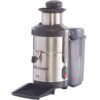
The J80 Ultra is a commercial centrifugal juicer from Robot Coupe, a French manufacturer whose equipment is more commonly found behind a counter than on one. The listing records dimensions of 21 by 9.25 by 19.75 inches, a weight of 16 pounds, France as the country of origin, and a first listed date of January 2010.
That is very nearly the whole record. The manufacturer description field is empty, no motor specification is published, no capacity is given, no voltage or amperage is recorded, and there is no customer rating data at all. The customer reviews field on this listing contains a sales rank string instead of a rating, which is a plain data fault. A figure of 3000 rpm appears in the product title, but the listing data does not confirm it, and it is not treated as established here.
What follows is therefore about the category and about what to establish before ordering, plus the small amount the record does support.
Centrifugal juicing, and where a commercial machine differs
A centrifugal juicer shreds produce against a fast spinning grating disc and throws the pulp outward against a mesh basket, where centrifugal force separates juice from fiber. It is fast, it handles hard produce like apples and carrots very well, and it struggles with leafy greens and wheatgrass, which pass through without being properly ruptured.
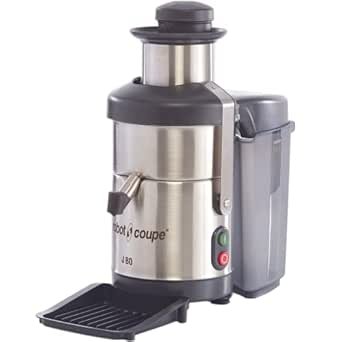
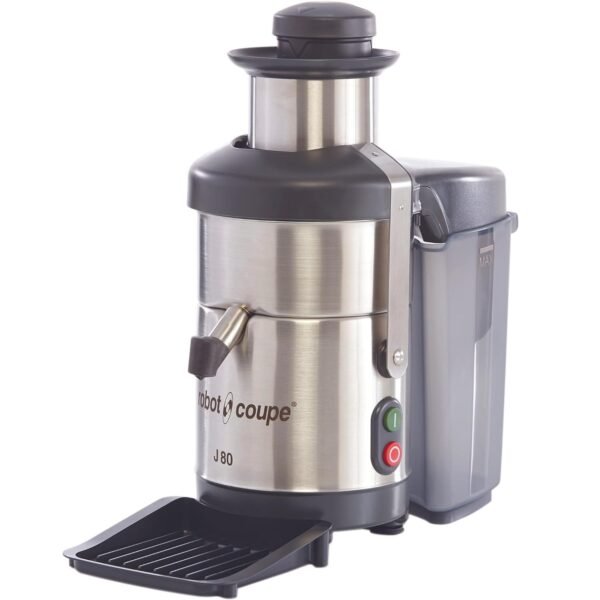
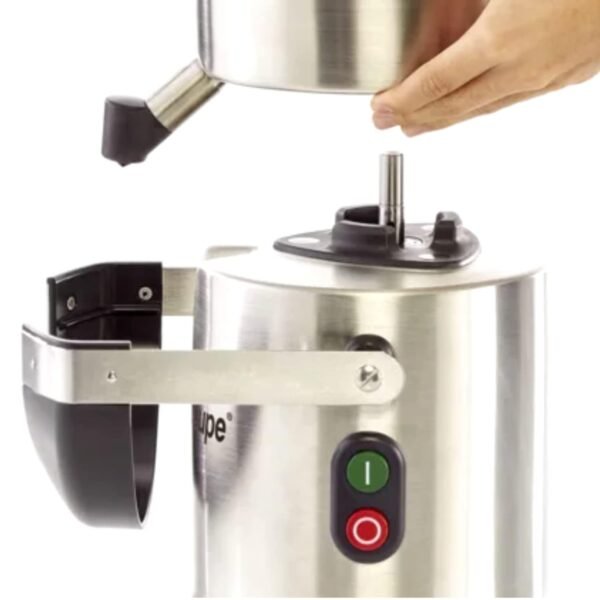
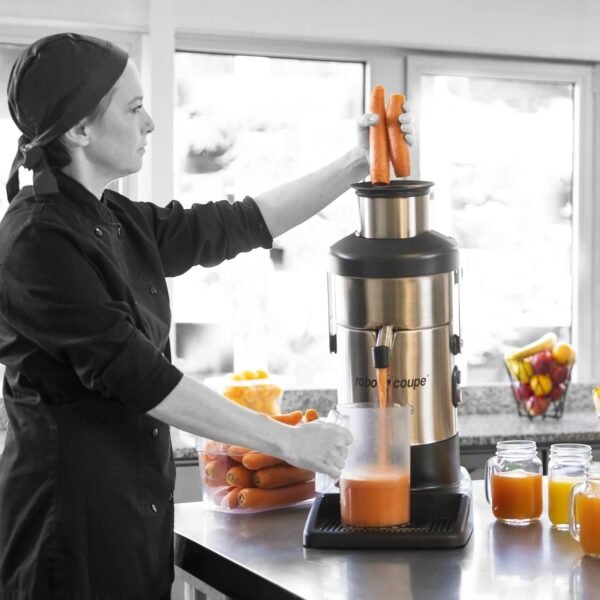
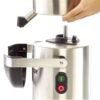
The distinction between a domestic and a commercial centrifugal juicer is not usually the speed. It is what happens to the pulp. A home juicer collects pulp inside the basket, which fills up and has to be stopped and cleaned every few minutes. Automatic pulp ejection, which is what the J80’s product name refers to, throws the pulp continuously into a separate external container, so the machine can keep running.
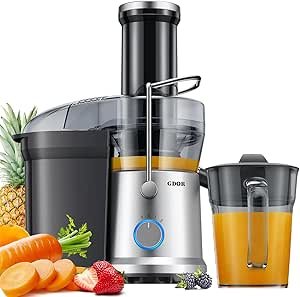
That single difference is the whole reason a juice bar buys equipment like this. It is the difference between juicing for four minutes and juicing for an hour. For a household making two glasses a morning it changes nothing, which is why a domestic machine such as the GDOR 1200W juicer is the more sensible purchase at home.
Cold press is a different machine entirely
Anyone comparing this against a masticating or cold press juicer such as the Kuvings AUTO10 should understand that they are different tools. A centrifugal machine is fast and introduces air and some heat through friction, which shortens how long the juice keeps. A cold press machine crushes slowly with an auger, is far better with greens, and produces juice that separates less and holds up longer. Speed against yield and shelf life is the trade, and a commercial operation choosing between them is choosing a service model, not just a machine.
What the footprint tells you
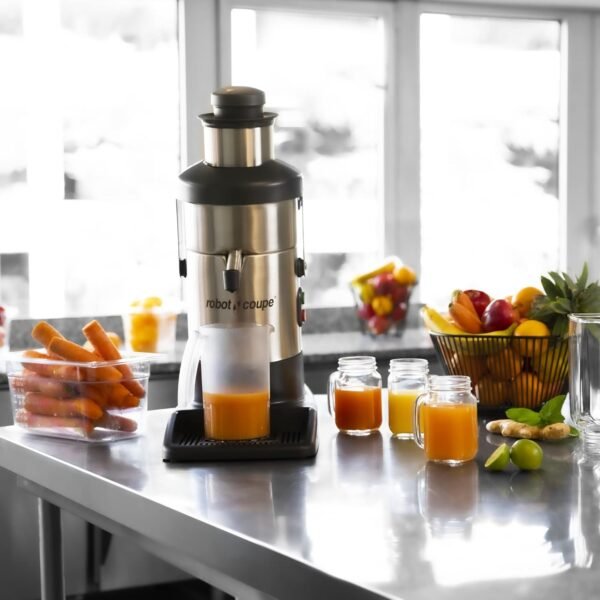
The one dimension worth dwelling on is the width. At 9.25 inches across, this is narrower than most domestic juicers, and it is 21 inches deep. That shape is deliberate and it is a commercial design decision rather than an accident. Behind a juice bar counter, width is the scarcest resource because every inch of frontage has to earn its place, while depth is usually available. A machine that is narrow and deep fits into a service line where a square one does not, and it also means the operator stands in front of a small target rather than reaching across a wide one.
The 19.75 inch height matters for a different reason. Produce is dropped into a feed chute at the top, which means clearance above the machine is required for a hand holding an apple, not just for the machine itself. Anyone planning an installation under a wall unit or a shelf should add several inches to the stated height before assuming it fits.
Highlights
- Automatic pulp ejection to an external container, which allows continuous operation rather than stop and clean cycles.
- Built by Robot Coupe, a manufacturer of commercial kitchen equipment rather than domestic appliances.
- Made in France.
- 21 inch depth and a 9.25 inch width, a narrow footprint for a machine of this type.
- On the market since 2010, which means a long service and spare parts history.
Things To Consider
The empty listing is the first problem. There is no published motor power, no feed tube diameter, no juice container capacity, no pulp container capacity, no noise figure and no electrical specification. For commercial equipment that is a serious gap, because a commercial kitchen has to know the electrical load before installing anything. Get the full specification sheet from Robot Coupe or the dealer.
The electrical question in particular needs answering before purchase. Commercial juicers can require more current than a standard domestic outlet supplies, and the record here does not say. Confirm the voltage, the amperage and whether a dedicated circuit is required.
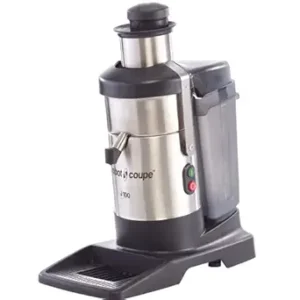
The 16 pound weight is worth flagging as inconsistent with the category. The closely related Robot Coupe J100 in the same catalog is listed at 39.73 pounds. A commercial centrifugal juicer with a heavy induction motor and a stainless body is generally a substantial machine, and 16 pounds is light for one. Treat the weight as unverified.
There is no rating data whatsoever, so there is no crowd feedback to weigh. Commercial equipment is normally bought through a dealer on the strength of a specification sheet and a service relationship, not on reviews, but a private buyer has neither.
Cleaning is the daily reality of any juicer. Commercial machines have more parts to strip than domestic ones, and a mesh basket left uncleaned becomes a hygiene problem quickly. Confirm which parts are dishwasher safe.
Who should buy it, and who should not
This is for a juice bar, a cafe, a hotel breakfast service, a supermarket counter or a catering operation that needs to run a juicer continuously and cannot afford to stop and empty a pulp basket. In that setting the automatic ejection and the Robot Coupe service network are the reasons to choose it.
It is the wrong purchase for a household. A domestic juicer costs a fraction as much, takes up less counter space, and does the same job for two glasses a day. Home buyers who want a fast machine should look at the centrifugal juicers category, and those who want maximum yield and better performance with greens should look at the masticating juicers category instead.