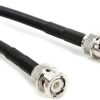
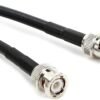
Description
Shure UA825 25-Foot BNC Antenna Extension Cable: what it is
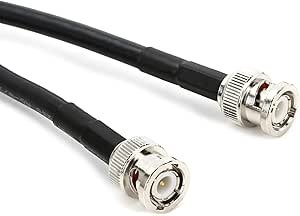
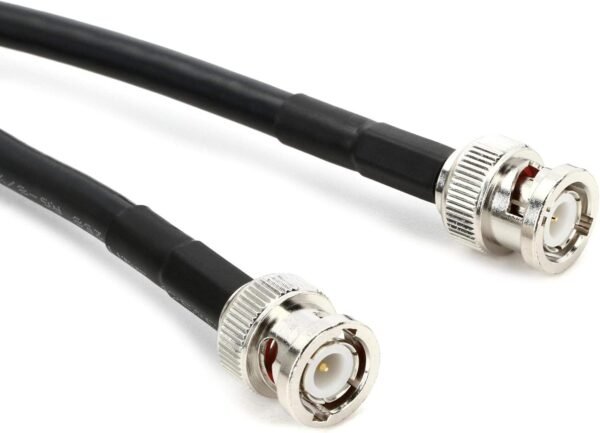
The UA825 is a 25 foot coaxial extension cable with BNC connectors at both ends, made by Shure for its wireless microphone systems. The manufacturer description is one line and it is precise: a 25 foot UHF remote antenna extension cable, BNC to BNC, RG8X/U type. The attribute table adds male to male connector gender, a coaxial cable type, a polyethylene outer jacket, a weight of 1.01 pounds and outdoor rated usage. The listing names compatible Shure equipment including the P9T and P10T transmitters and the QLXD4, BLX4R, SLX4, SLXD and ULXD receiver families.
It needs saying clearly at the outset that this is not a television antenna and not a radio antenna. It is a cable. It is filed under the radio antennas category on this site because that is where it landed in the source catalog, and it is not a natural fit alongside the television and kitchen products around it. Anyone who arrived here looking for something to receive broadcast television should be in the TV antennas category instead, where a product such as the Antennas Direct 91XG does the job this cable does not.
What the cable is actually for
Professional wireless microphone receivers have antennas mounted on the receiver itself, which is usually in a rack at the side or rear of a room. That is frequently the worst possible place for radio reception, because the antenna ends up behind metal, behind people, or below the level of the stage. The standard fix is to relocate the antennas out to where they can see the performers, and a BNC extension cable is what carries the signal from the remote antenna back to the receiver.
Twenty five feet is a sensible length for that job in a small to medium venue: front of stage back to a side rack, or a rack position out to a corner mount. It is a single run, not a distribution system, so a multi receiver rack normally needs an antenna distribution amplifier as well rather than one cable per receiver.
RG8X and why cable loss matters
The cable type is stated as RG8X/U, which is a mid diameter coaxial cable. This matters because coaxial cable loses signal as it goes, and the loss rises with frequency. Wireless microphone systems operate in the UHF range, which is exactly where cable loss is significant rather than negligible.
The practical consequence is that a remote antenna run is a trade, not a free improvement. Moving the antenna to a better location gains signal. The cable between the antenna and the receiver loses some of it back. At 25 feet with RG8X the trade is usually strongly favorable, which is why this length is a standard product. At much longer distances, an in line antenna amplifier or a lower loss cable type becomes necessary. Shure publishes guidance on this for its own systems, and anyone planning a run substantially longer than this cable should read it before buying more cable.
The corollary is equally important: an extension cable does not improve reception on its own. It relocates the antenna. If the antenna ends up somewhere worse, the result is worse. All the benefit comes from where the antenna is put.
Highlights
- 25 foot length, a standard run for relocating a wireless microphone receiver antenna in a small or medium venue.
- BNC male to male connectors, which is the standard interface on professional wireless receivers.
- RG8X/U coaxial construction with a polyethylene outer jacket.
- Listed compatibility across a broad range of Shure systems including QLXD, BLX, SLX, SLXD and ULXD receivers and the P9T and P10T transmitters.
- Rated for outdoor use in the listing.
- Just over one pound, so it adds nothing meaningful to a rack or a truss load.
Things To Consider
The customer feedback base is very small. Twenty six ratings averaging 4.9 stars is a strong score on a tiny sample, and a sample that size cannot tell you much about consistency across production runs. Cables are also a product category where counterfeits circulate, so buying from a source that can confirm authenticity is worth the effort on a professional system.
Several fields in this listing do not describe what they appear to describe. The product dimensions are recorded as 7.5 by 7 by 1 inches, which is the coiled package rather than a 25 foot cable. The compatibility list appears under a field labeled for phone models, when what it actually lists is Shure wireless transmitters and receivers. The number of pins is recorded as 2, which is a slightly odd way to describe a coaxial connection with a center conductor and a shield. None of these are faults in the product. They are faults in the record.
The cable is sold on its own. It does not include an antenna, a mount, an antenna distribution amplifier or a bulkhead adapter, all of which a real remote antenna installation may need.
Finally, this product has been listed since 2004. That is a sign of a stable professional standard rather than of obsolescence, since BNC and RG8X have not changed, but it does mean the listing predates most of the compatible equipment named on it.
Who should buy it, and who should not
This is for someone running Shure wireless microphones in a church, a school hall, a conference room, a small theater or a mobile production rig, who needs to move a receiver antenna out of a rack and into a position where it can actually see the transmitters. In that specific job it is the correct part, made by the same company as the system.
It is the wrong product for anyone shopping for television or radio reception. It receives nothing on its own. Households looking to pick up free broadcast television should start with a real antenna and a coverage lookup for their address, and the relevant products sit in the radio antennas category, including real receiving designs such as the Diamond X30A dual band base antenna, and among television designs such as the Winegard FL5500A. It is also the wrong product for a run much longer than 25 feet, where cable loss starts to undo the benefit of relocating the antenna at all.