Description
Vizio V4K43M-08 43-Inch 4K UHD Smart TV: what it is and who it suits
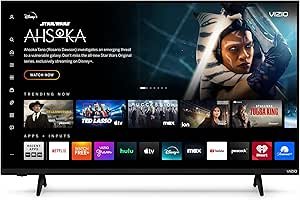
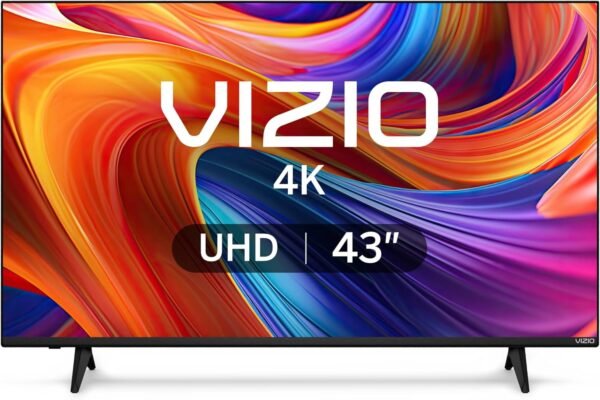
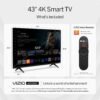
The V4K43M-08 is Vizio’s 43-inch entry in the V-Series, the company’s value 4K line. The listing records a 43-inch standing screen display size, a 16:9 aspect ratio, a 3840 by 2160 class 4K panel and a February 2024 first availability date, which places it among the more recent V-Series revisions. It is an LED backlit LCD set, not a quantum dot or OLED panel, and Vizio positions it as the screen you buy when you want current streaming features and a modern smart platform without the cost of a flagship.
Forty three inches is the size that works in a bedroom, a small apartment living room, a home office or a second television in a finished basement. At a typical eight foot viewing distance a 43-inch screen fills a reasonable portion of the field of view without dominating the room. Anyone furnishing a larger living space should look at the 50-inch Vizio V4K50C-0809 or step up several sizes to something like the LG 65-inch UQ7570 instead.
Picture: what the listing confirms and what it does not
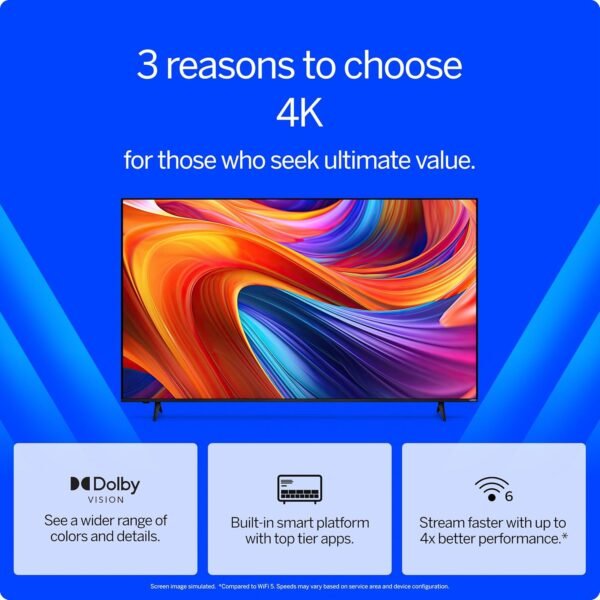
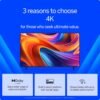
The specification list names Dolby Vision HDR as a supported format, along with what Vizio calls its Spatial Scaling Engine on related models in this family. Dolby Vision is dynamic metadata HDR, meaning tone mapping instructions travel with the content scene by scene rather than being set once for the whole title. On a set in this price class the practical effect is modest, because HDR needs peak brightness and local dimming to really show itself, and the listing publishes neither a brightness figure nor a backlight zone count. Treat Dolby Vision here as format compatibility rather than as a promise of high dynamic range impact.
Two points of honesty about the panel. First, the listing does not state the native refresh rate. Vizio, like every other maker, has historically marketed processed motion figures on V-Series sets, and those numbers are not the panel’s refresh rate. Anyone who needs 120 Hz for console gaming should confirm the native figure before ordering rather than reading a marketing motion number as a hardware specification. Second, the specification block on this listing names Dolby Vision but does not name HDR10+ or HLG, even though the short description carried on the page previously claimed them. Where the listing does not confirm a format, this review does not claim it.
Size, weight and mounting
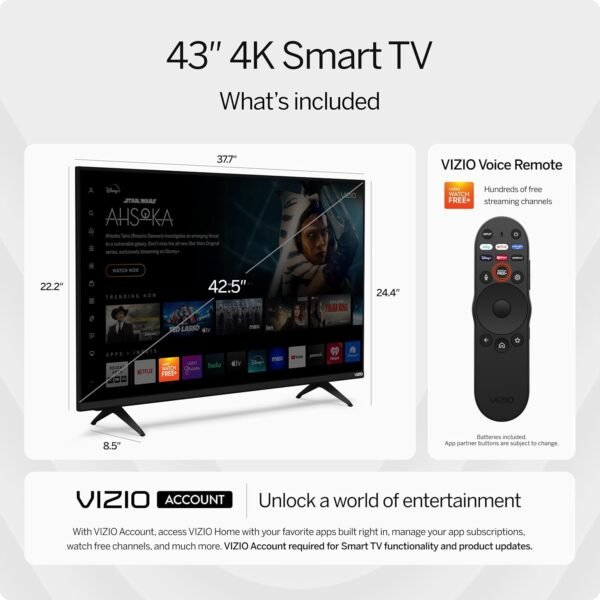
The listing gives product dimensions of 9.37 by 37.68 by 24.21 inches and a weight of 22 pounds. Those numbers are consistent with a 43-inch 16:9 panel measured with the stand attached, since the panel itself is roughly 38 inches wide, and the 9.37 inch depth is clearly the stand footprint rather than the cabinet. Twenty two pounds is a one person lift, which makes this an easy set to wall mount with a bracket such as the Mounting Dream MD2296.
Smart platform, connectivity and gaming
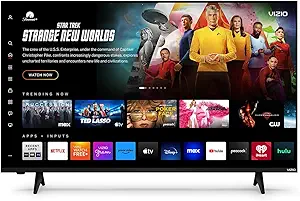
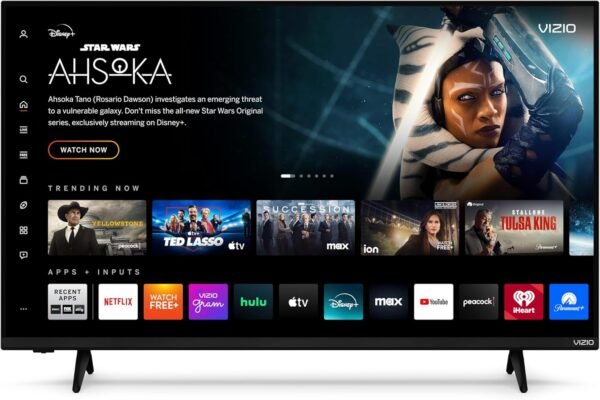
The special features list is the most detailed part of this listing and it is worth reading closely: Apple AirPlay, Google Chromecast built in, VIZIO OS with built in apps, hundreds of free channels, Bluetooth headphone compatibility, a voice remote, voice assistant integration, closed captioning and a sleep timer. The manufacturer description adds Wi-Fi 6 for the network side.
Two of those matter more than the rest. Bluetooth headphone support is genuinely useful for late night viewing without waking a household, and it is not standard across every brand at this price. Wi-Fi 6 helps in an apartment building where the 2.4 GHz band is congested, though it only helps if the router also speaks Wi-Fi 6. AirPlay and Chromecast together mean both iPhone and Android households can push video to the screen without extra hardware.
Vizio also lists Auto Low Latency Mode, which switches the set into a low lag picture preset when it detects a game console. That is a real convenience feature. It reduces input lag from the picture processing chain, but it cannot change the panel’s refresh rate, so it is not a substitute for confirming that figure.
Highlights
- 43-inch 4K class panel at a 16:9 aspect ratio, first listed in February 2024.
- Dolby Vision HDR support confirmed in the listing specification list.
- Apple AirPlay and Google Chromecast both built in, so iOS and Android devices can cast without a dongle.
- Bluetooth headphone compatibility for private listening.
- Wi-Fi 6 networking per the manufacturer description, useful on congested home networks.
- 22 pounds with the stand, an easy single person wall mount.
- Auto Low Latency Mode for consoles, plus a voice remote.
Things To Consider
The customer feedback base is thin. The listing records 209 ratings averaging 4.3 stars. That is enough to show no widespread defect, but it is a small sample for a television, and the 2024 launch date means long term reliability data simply does not exist yet for this revision.
The unpublished refresh rate is the main specification gap, followed by the absence of any brightness figure or local dimming zone count. Without those, the Dolby Vision badge cannot be read as a performance claim.
V-Series sets are value engineered, and the compromises usually show up in off angle viewing and in backlight uniformity rather than in outright sharpness. If several people watch from a wide couch, a set at this level will show color and contrast shift toward the edges of the seating.
The built in audio is a two channel system in a thin cabinet. Anyone who watches dialogue heavy content should plan on a soundbar. And as with any smart television, the app selection is controlled by the services rather than by Vizio, so what is available today may change.
Who should buy it, and who should not
This suits a bedroom, a small living room, a dorm or a home office where 43 inches is the right size and Dolby Vision compatibility plus casting from both phone ecosystems covers the real requirements. It is a sensible pick for someone replacing an older 1080p set of similar size, since the physical footprint will be close to what is already on the stand.
It is the wrong buy for a dark room home theater, where the raised black levels of an LED LCD without published local dimming will be obvious, and where a self emissive panel like the LG OLED C1 is a different class of picture. It is also the wrong buy for a competitive gamer who needs a confirmed high refresh panel. Anyone wanting a wider color range from a quantum dot layer should compare against the Vizio M65Q6-L4 and the rest of the QLED TVs category.