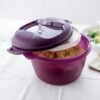
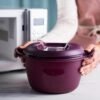
Description
What the Tupperware microwave rice cooker is
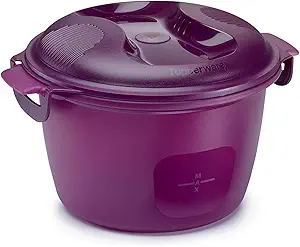
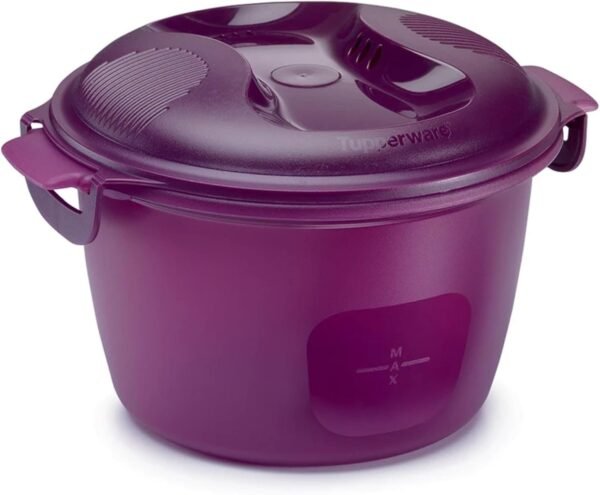
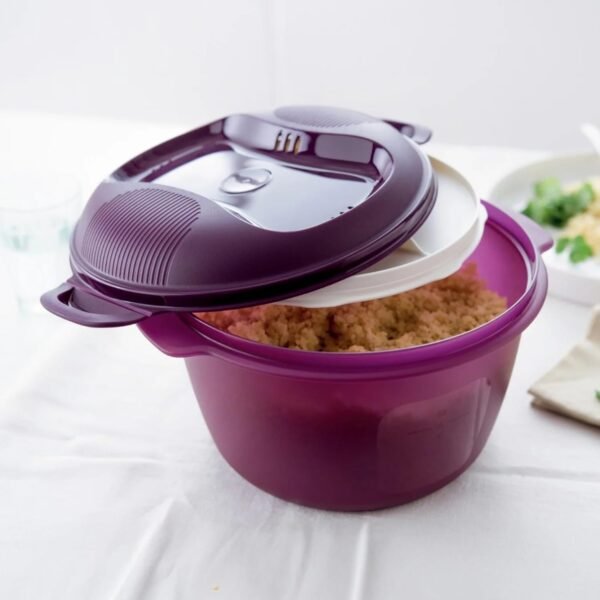
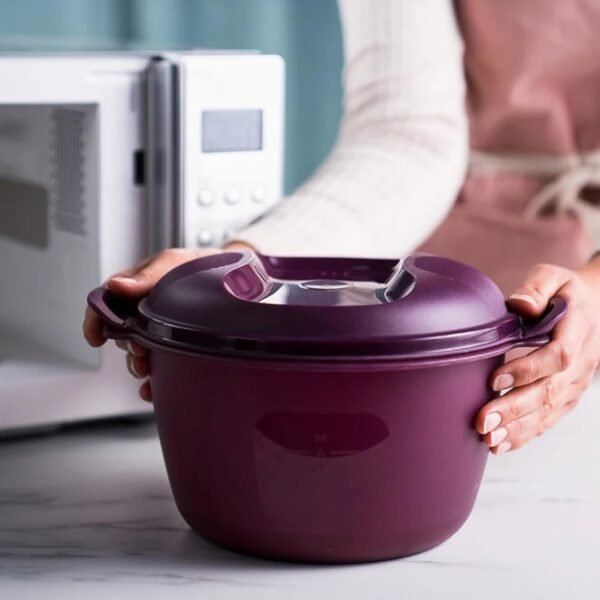
This is a plastic vessel with a lid that cooks rice in a microwave. There is no element, no thermostat and no timer. Rice and water go in, the cover goes on, and the microwave does the work at power levels and times the user chooses. It is a container, not an appliance, and judging it as one is the right starting point.
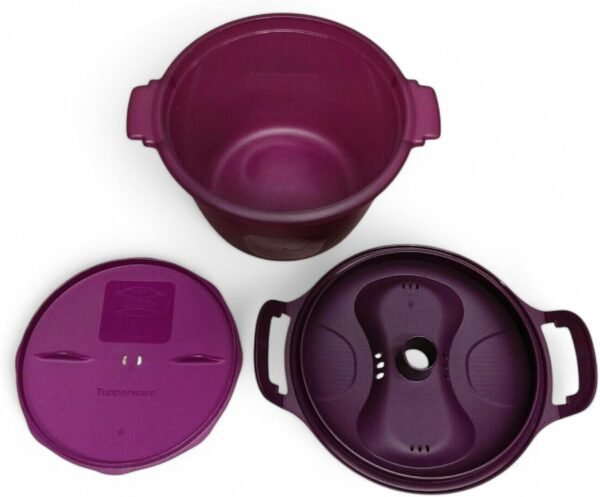
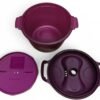
Tupperware’s design contribution is the double cover. Rice boils over readily in a microwave because the starch in the water foams as it heats, and that foam is what ends up on the floor of the oven. The double cover catches the foam, channels it into a recessed area in the lid, and drains it back into the base as the contents settle. Whether or not it eliminates every spill, the mechanism addresses the actual failure mode of microwave rice cooking, which is more than a plain lidded container does.
Fill guidelines for rice and water are marked on the outside of the base, so the ratio is set by reading the container rather than measuring separately. The cover handles fold down and lock onto the base, which gives a solid grip for lifting a hot vessel out of a microwave. Both are sensible, unglamorous design decisions.
The capacity problem
The capacity of this product is stated three different ways in the same listing and they do not agree.
The product name says 3 liters or 12 cups. The attribute table says 2.2 liters. The description says it makes up to 4 cups of cooked rice. Those are not three ways of saying the same thing. Three liters and 2.2 liters are different volumes. Twelve cups and four cups are different quantities. The most likely reconciliation is that the vessel’s total volume is somewhere between 2.2 and 3 liters, that 12 cups refers to that volume in US cups rather than to rice, and that 4 cups of cooked rice is the realistic working capacity once expansion and headroom for foam are accounted for.
Treat 4 cups of cooked rice as the number to plan around, because it is the only figure in the listing that describes the food rather than the container. Anyone buying for a large household on the strength of the 12 cup figure in the title is likely to be disappointed.
Materials, cleaning and the limits
The body and lid are plastic, the color is purple, and the whole thing weighs 10.8 ounces. Published dimensions are 6.2 inches deep by 8 inches wide by 9.8 inches high, and that height needs checking against the interior of your microwave, particularly on a turntable model where the vessel has to rotate without catching.
Tupperware lists it as dishwasher safe. It also states, in its own feature text, that the cover is not liquid tight. That is an important limitation stated plainly: this holds leftovers in the refrigerator but should not be carried around or tipped on its side. The same feature text says leftover rice and grains can be stored and reheated in the microwave as needed, and specifically that it is microwave reheatable only, which rules out a conventional oven.
One attribute is simply wrong. The power source is listed as electric. This product has no power source at all. It is a passive container that relies entirely on the microwave it sits in. The special features field also lists non stick, which is not a coating claim that a plain plastic vessel supports.
How microwave rice cooking actually behaves
A microwave heats the water, not the vessel, which is why a passive container can cook rice at all. It also means the result depends far more on the oven than on the container. A 1000 watt microwave and a 700 watt microwave will need noticeably different times for the same quantity, and Tupperware says so directly: it instructs users to keep rice and water within the marked guidelines and to use the correct power level and time for their own microwave.
What that means in practice is a short calibration period. The first two or three attempts establish the timing for one particular oven and one particular type of rice, and after that the process is repeatable. Long grain, short grain and parboiled rice all absorb differently, and none of that is on the container. Buyers expecting an appliance that decides these things for them will be disappointed; buyers who understand they are buying a well designed vessel will not.
Highlights
- Double cover that catches boil over foam and drains it back into the base.
- Fill guidelines for rice and water marked on the outside of the base.
- Folding cover handles that lock to the base for lifting a hot container.
- Dishwasher safe.
- Doubles as refrigerator storage, with microwave reheating.
- Very light at 10.8 ounces, and nothing to plug in.
- Steam vent in the cover.
Things To Consider
- Capacity is stated as 3 liters, 2.2 liters and 4 cups of cooked rice in three different places in the same listing.
- The cover is not liquid tight. Tupperware states this directly. Do not treat it as a sealed transport container.
- Microwave reheatable only. It cannot go in a conventional oven.
- The power source attribute reads electric, which is wrong. This is a passive container with no power of its own.
- The non stick claim in the attribute table is not supported anywhere else in the listing.
- Results depend entirely on your own microwave’s power and on choosing the right power level and time. Tupperware says so explicitly and provides no chart in the listing.
- At 9.8 inches tall it needs to be checked against the interior height of your microwave, especially on a turntable.
- The manufacture year is listed as 2024 while the product has been available since June 2016.
Who it suits
This is a good buy for a small household, a dorm room, an office kitchen or anywhere a countertop appliance cannot be justified. It cooks rice with no additional equipment, stores the leftovers, reheats them and goes in the dishwasher, all for a fraction of the counter space and cost of an electric cooker. For someone cooking rice two or three times a week for one or two people, it does the job.
It is not for a household that cooks rice in quantity, that wants keep warm and timer functions, or that cooks varieties needing precise control. Those buyers should look at an electric machine such as the Zojirushi NS-ZCC10 with fuzzy logic, the Aroma ARC-914D or the compact GreenPan ceramic nonstick cooker, and read across the rice cookers category. Anyone wanting a cheap electric alternative rather than a microwave vessel should compare the Brentwood TS-10.