

Description
LG UR9000 Series 55-Inch 4K Smart TV: what this set is
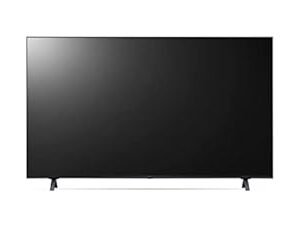
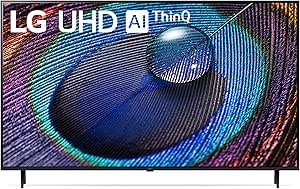
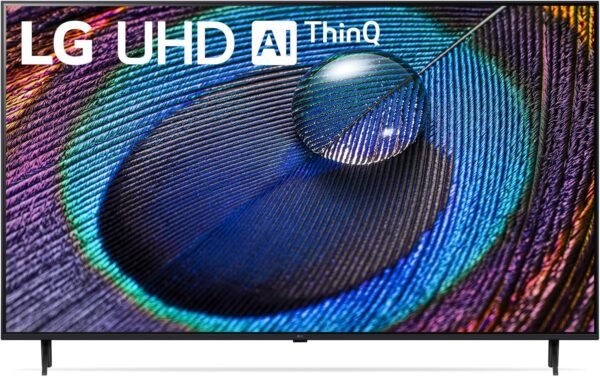
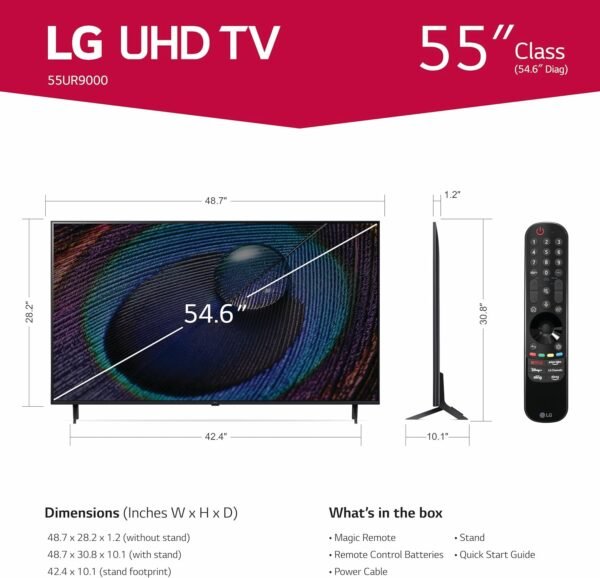
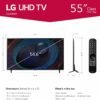
The LG UR9000 Series 55-Inch is a 4K LED backlit LCD television, and it sits in the part of LG’s range that most people actually shop from. LG splits its televisions into families: the OLED sets, the QNED and quantum dot sets, and the plain UHD sets that carry a “U” model prefix. The UR9000 belongs to that last group. It is a conventional LED backlit LCD panel with a 3840 by 2160 pixel grid, running LG’s webOS smart platform, and it is aimed at the buyer who wants a large, current 4K screen for a living room or a bedroom without paying for self emissive panel technology.
Before going any further, one thing needs stating plainly, because it shapes everything below. The listing for this particular unit carries no specification table and no manufacturer description. There is no published weight, no stated panel refresh rate, no port count, no HDR format list and no brightness figure attached to the item record. That is unusual, and it is not a small gap. Everything here is therefore limited to what the model name, the screen size and the product category establish, plus general guidance about how a set of this type behaves. Nothing below is invented to fill the hole, and where a number is missing it is named as missing rather than guessed.
Panel technology and what 4K actually buys you at 55 inches
The UR9000 is an LED backlit LCD. That matters, because the three panel families sold as “4K TVs” behave very differently and listings across this category blur them constantly. An LED LCD produces light from a backlight behind the panel and blocks it with a liquid crystal layer, which means black is really very dim gray, and contrast depends on how finely the backlight can be dimmed. A quantum dot set such as the VIZIO M65Q6-L4 QLED is still an LCD, but it adds a quantum dot layer that widens the color range. An OLED such as the LG OLED C1 55-inch lights each pixel individually and can switch a pixel fully off. If deep black in a dark room is the priority, an LED LCD is the wrong starting point regardless of brand.
At 55 inches, 3840 by 2160 resolution is comfortably past the point where an average viewer at a normal couch distance can resolve individual pixels. The practical benefit of 4K on a screen this size is less about visible sharpness and more about the fact that the entire content ecosystem, from streaming apps to game consoles, now targets it. A 55-inch panel suits a viewing distance of roughly six to nine feet in most rooms.
Refresh rate: the number to verify before ordering
The listing does not state the native refresh rate of this panel, and that is the single specification most worth confirming with LG or the retailer. Television marketing is full of processed motion figures with names like TruMotion, Motion Rate and Clear Motion Index, and those numbers are not the panel’s refresh rate. A set with a 60 Hz panel and heavy motion interpolation can be advertised with a much larger figure. Anyone playing console games at 120 frames per second, or watching a lot of fast sports, should ask for the native panel refresh rate in hertz and accept no substitute.
Smart platform and everyday use
LG televisions in this family run webOS, LG’s own smart platform, with the Magic Remote pointer style controller depending on the exact regional package. In practice the built in platform on any brand ages faster than the panel does. App support gets dropped, interfaces slow down after a few years of updates, and services change their requirements without asking the television maker. That is the strongest argument for treating the built in apps as a convenience rather than the reason to buy the set. A cheap external streaming player or a more capable Android box can be swapped out in three years for very little money, while the panel stays.
Since the listing does not publish the port count, plan inputs conservatively. Assume an HDMI switch or a soundbar with pass through may be needed to connect a console, a disc player and a streaming stick at the same time, and confirm the number of HDMI ports before ordering if that matters to the setup.
Highlights
- 4K resolution at 3840 by 2160 across a 55-inch screen, a size that fits most living rooms and viewing distances between six and nine feet.
- LED backlit LCD construction, which copes with bright rooms better than it copes with dark ones.
- Part of LG’s mainstream UHD line rather than the OLED or quantum dot lines, so it is positioned as an everyday screen rather than a reference display.
- Runs LG’s webOS smart platform with the usual major streaming apps built in.
- A common 55-inch size, which makes wall mount bracket selection straightforward.
Things To Consider
The missing listing data is the headline concern. A product record with no weight, no dimensions, no refresh rate and no HDR format list gives a buyer nothing to compare against a competing set. Anyone cross shopping should insist on those figures from LG’s own product page before committing, and should be aware that exact feature sets can vary by region and by production run on television models sold under a series name.
Black level is the structural limitation of the technology, not a defect of this model. In a dark room, an LED LCD shows raised blacks and, on scenes with bright objects against dark backgrounds, some halo around them. That is the trade for the lower price of the category.
Built in television speakers in this class are thin. The cabinet is too shallow to move much air, and dialogue clarity in particular tends to suffer. Budget for a soundbar for drama or anything with a dense audio mix.
Finally, if the plan is to feed this set with over the air broadcast rather than streaming, the tuner is only half the equation. Reception depends entirely on the address and the terrain between it and the transmitters, and an outdoor antenna such as the Antennas Direct Yagi 91XG only helps if the towers in question are actually reachable from that location.
Who should buy it, and who should not
This suits someone furnishing a bright living room or a main bedroom who wants a large, current 4K screen from a major brand without paying OLED money. It is also a reasonable pick for a family television that will be on during the day with curtains open, since LED LCD holds up better under ambient light than the specification sheets suggest.
Skip it for a dark room home theater, where an OLED such as the Sony BRAVIA XR A80L answers a different question entirely. Skip it too if a confirmed 120 Hz panel is needed for gaming, because this listing does not establish one. And for a smaller second screen rather than a main set, something like the Samsung 40-inch Full HD smart set covers that job for less. The wider range of comparable sets sits in the LED and LCD TVs category.