

Description
What the LG 65UN7300PUF is
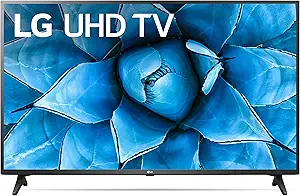
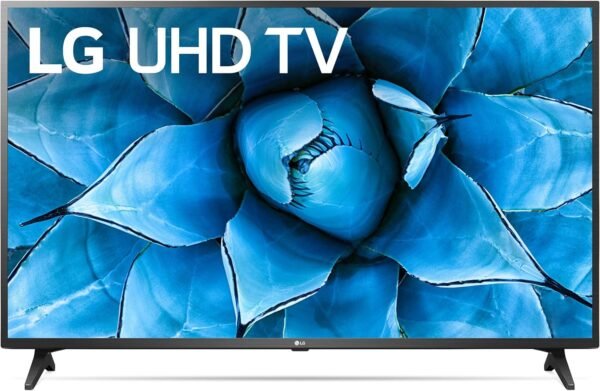
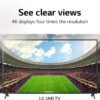
The 65UN7300PUF is a 65 inch class television from LG’s UN7300 range, part of the 73 Series and dating to 2020. The panel is an LED backlit LCD with native 4K resolution. It is not an OLED, and anyone comparing it against LG’s OLED line such as the LG OLED C1 is comparing two entirely different display technologies.
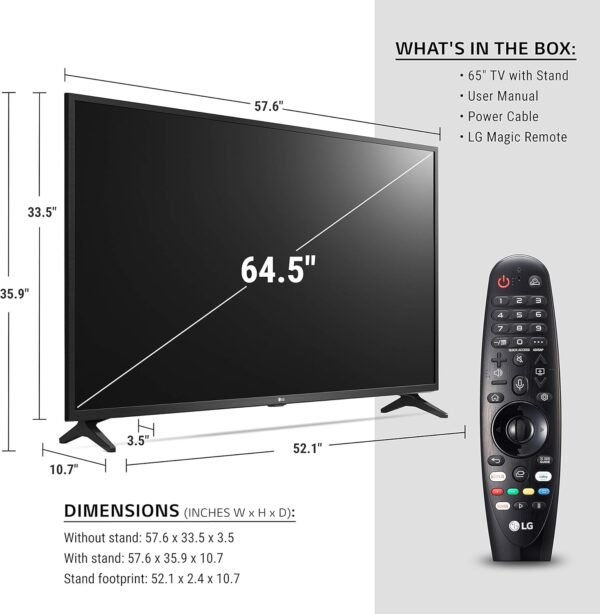
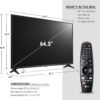
LG publishes an unusually complete set of physical specifications here, which is welcome. With the stand the set measures 57.6 by 35.8 by 10.0 inches and weighs 47.4 pounds. Without the stand it is 57.6 by 33.5 by 3.5 inches and weighs 47.0 pounds. Those are the numbers needed to plan a media unit or a wall mount, and most television listings on this site do not provide them.
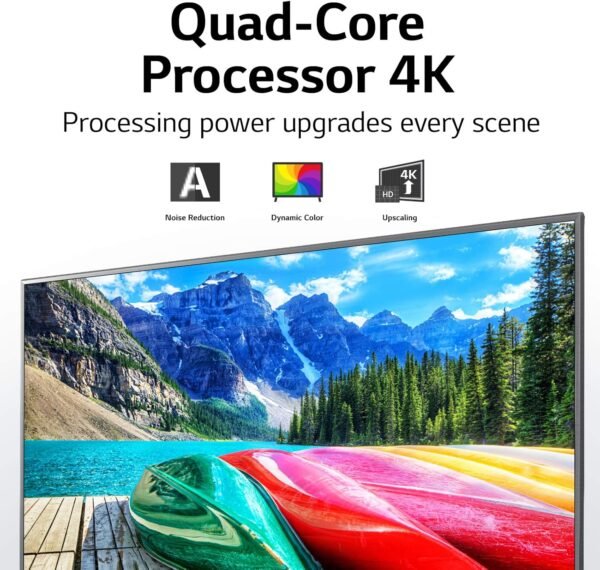
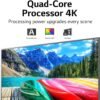
Processing is handled by what LG calls a Quad Core Processor 4K. The listing describes it as enhancing color, contrast, clarity and detail, which is the standard description of an upscaling and image processing chip rather than a specific capability.
Ports, and why three HDMI matters
The input list is fully specified: three HDMI ports, one Ethernet port, two USB 2.0 ports, one optical digital audio output and one composite AV input. Bluetooth is listed under connectivity.
Three HDMI ports is the practical number. A soundbar, a games console and a streaming device fill exactly three, and the two port sets found on cheaper televisions force a choice or a switch box. The optical output covers older audio equipment that predates HDMI ARC, and the composite input is a genuine rarity on modern sets, useful for a legacy games console, a VCR or a camcorder. Anyone digitizing old tapes with something like the Wolverine TransMedia will appreciate having somewhere to plug in the source.
The USB ports are version 2.0 rather than 3.0, which limits playback of very high bitrate files from a drive but is adequate for photos, music and ordinary video.
HDR support, stated exactly
LG calls the feature Active HDR and states that it supports a wide range of formats for scene by scene picture adjustment, including HDR10 and HLG.
Those two named formats are what the listing confirms. HDR10 is the baseline static metadata standard used by most 4K content, and HLG is the broadcast format used for live HDR television. Dolby Vision is not mentioned anywhere, and on LG’s UN series it is generally not included. Anyone who specifically wants Dolby Vision should confirm it rather than assume it from the phrase wide range of formats.
What the listing does not give is any measure of HDR performance. There is no peak brightness figure, no contrast ratio, no local dimming statement and no color gamut coverage. There is also no refresh rate, and no motion rate marketing figure, so nothing can be said about the panel’s motion handling.
webOS, the Magic Remote and two data faults
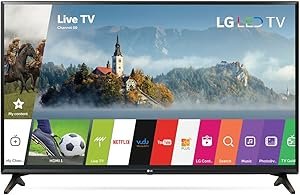
The platform is webOS, LG’s own operating system, paired with the Magic Remote. The Magic Remote is the genuinely distinctive part: it works as a motion pointer, so the cursor follows where the remote is aimed, with a scroll wheel and voice control. For entering text or navigating a dense interface it is considerably faster than a directional pad, and it is the reason many people prefer LG’s platform.
Voice assistant support is broad. Alexa and Google Assistant are both built in, and Apple AirPlay 2 and HomeKit are supported, which means the set works with essentially any smart home ecosystem. FilmMaker Mode is listed, which disables motion smoothing and other processing to present film content as it was mastered.
Two entries in the attribute table are wrong and should be ignored. The color name field reads 43 inch 43UQ7070ZUD, which is a different LG television entirely. The aspect ratio is recorded as 1.58 to 1; a 4K television is 16:9, which is 1.78 to 1.
Buying a 2020 model now
There is a practical question attached to any set that has been on the market for several years. The panel and the ports do not age; a 4K display with three HDMI inputs works the same way it did on release. What ages is the software. Smart platform updates taper off, streaming apps raise their minimum requirements, and a set that runs everything today may drop an app in a few years.
That is not a reason to avoid an older model, and it is a reason to think about how the television will be used. A set bought as a display, with a separate streaming player supplying the apps, sidesteps the problem entirely and can be kept for as long as the panel lasts. A set relied on for its built in platform has a shorter effective life than its hardware.
Highlights
- 65 inch class LED backlit LCD with native 4K resolution.
- Three HDMI ports, two USB 2.0, Ethernet, optical audio output and a composite input.
- Active HDR supporting HDR10 and HLG.
- webOS platform with the Magic Remote, offering motion pointer and voice control.
- Alexa and Google Assistant built in, plus Apple AirPlay 2 and HomeKit.
- FilmMaker Mode for viewing film content without added processing.
- Complete physical dimensions published, with and without the stand.
- Bluetooth connectivity.
Things To Consider
- Dolby Vision is not listed. Only HDR10 and HLG are confirmed.
- No refresh rate is published anywhere.
- No peak brightness, contrast ratio or local dimming information is given.
- The color name field contains a different television model entirely.
- The aspect ratio is recorded as 1.58 to 1, which is wrong for a 16:9 set.
- USB ports are 2.0, which limits high bitrate playback from a drive.
- This is a 2020 model, so platform updates and app support have a shorter remaining horizon than a current set.
- No VESA mounting pattern is published despite the otherwise complete dimensions.
Who it suits
This suits a household that wants a large 4K screen with a well regarded interface and enough inputs to avoid compromises. The Magic Remote is a real usability advantage, the voice assistant and AirPlay coverage is broader than most sets offer, and the composite input is genuinely useful for anyone with older equipment.
It is not for someone who wants Dolby Vision, high frame rate gaming or documented HDR performance. Buyers looking at newer LG sets should compare the LG 65 inch UQ7570 and the LG UR9000 series in the LED and LCD TVs category, and anyone whose priority is black level should read across the OLED TVs category instead. At 47 pounds this is within reach of a standard bracket such as the Mounting Dream MD2296, subject to confirming the VESA pattern.