Description
What the Zidoo Z3000 Pro is
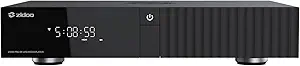
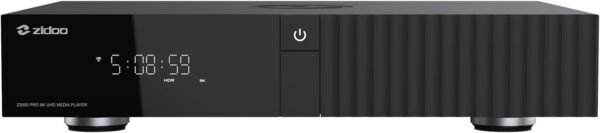
The Z3000 Pro is not a streaming stick with ambitions. It is a home theater source component that happens to run Android, aimed at people who own ripped Blu-ray discs, high resolution audio files and an audio video receiver, and who want a device that plays all of it properly.
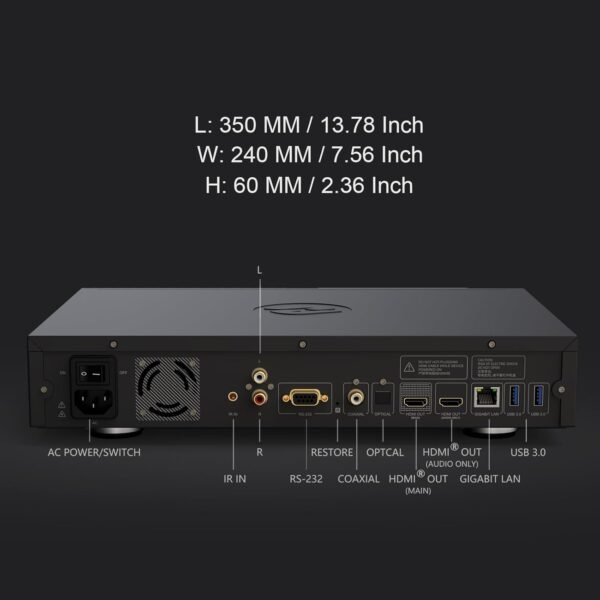
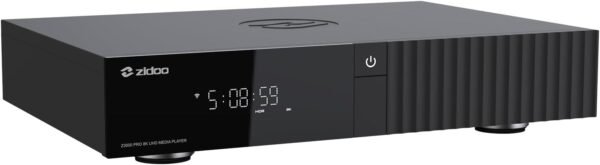
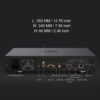
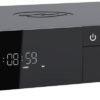
The processor is an Amlogic S928X-K with ARM Cortex-A76 and Cortex-A55 cores. The chassis has a brushed aluminum panel and a large LED display, measures 13.78 by 9.45 by 2.37 inches and weighs 8.03 pounds, which puts it in a rack alongside an amplifier rather than behind a television. The operating system is Android 11 with over the air updates and a companion controller app for phones and tablets.
Storage is where it separates from every other box in the category. There is a hidden internal drive bay taking a SATA 3.0 disk, two USB 3.0 ports and one USB 2.0, with drive support stated up to 24TB. It also speaks NFS, SMB versions 1 through 3, UPnP and WebDAV, and runs its own SMB server so other devices can read from it.
Dual HDMI, and why it matters
The most useful feature here solves a specific and expensive problem. Modern video formats and modern audio formats have outrun many otherwise capable AV receivers: a receiver that decodes Dolby Atmos beautifully may not pass 4K HDR video, which forces an owner to choose between picture and sound or replace the receiver.
Two HDMI outputs remove the choice. The main output goes straight to the television carrying video, and the audio only output goes to the receiver carrying sound. The receiver never has to handle the video signal, so its video limitations stop mattering. Zidoo also states the audio only port supports native DSD output.
The main HDMI is 2.1 and rated for 8K at 60Hz, 12 bit, point to point. Note that 8K content is scarce, and the more relevant capability for most owners is what HDMI 2.1 bandwidth allows at 4K.
HDR handling and the VS10 engine
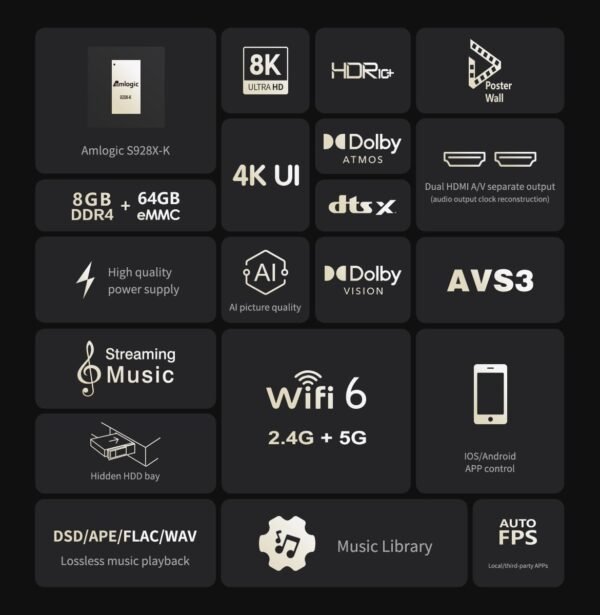
HDR support covers HDR10, HLG, HDR10+ and Dolby Vision, which is every format currently in use. Zidoo goes further than most by describing what it does with them: processing HDR10 static metadata including MaxFALL and MaxCLL, acquiring and processing HDR10+ dynamic metadata frame by frame, and outputting low latency Dolby Vision through its VS10 image engine.
VS10 is worth understanding. It is a processing engine that can map non Dolby Vision content into a Dolby Vision output, which is useful for a television that handles Dolby Vision well and other formats less well. It is customizable, which suits an enthusiast and will mean nothing to a casual buyer.
Automatic frame rate and resolution switching is the feature that matters most in daily use and gets the least attention. Film is shot at 23.976 frames per second, and a player that outputs everything at 60Hz introduces judder into every pan. Switching output to match the source removes it.
Audio, formats and the memory contradiction
The audio specification is the reason this device exists for some buyers. Atmos and DTS:X pass-through, lossless playback of DSD including SACD ISO, DFF and DSF, and lossless CD formats WAV, APE and FLAC, up to DSD512 and PCM at 192 kHz, over HDMI or SPDIF. Video codec support covers AV1, VP9, H.265, AVS3 and AVS2, with BD and UHD Blu-ray menu playback from BDMV and ISO including gapless branching on discs with complex playlist structures.
The one clear contradiction is memory. The product name says 6G plus 64G. The description says 8GB DDR4 RAM plus 64GB eMMC. The feature bullets also say 8G DDR4. Two of three sources say 8GB, but the title says 6GB and the listing never reconciles it. The core count is inconsistent too: the description says penta-core while the feature bullet says quad-core for the same processor.
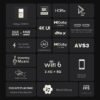
Networking is gigabit Ethernet plus dual band Wi-Fi 6 and Bluetooth 5.2, with the wireless antennas built in. Zidoo states there is no 3D output.
Network playback and the library case
The protocol list is the part of this specification that tells you who the device is for. NFS, SMB versions 1 through 3, UPnP and WebDAV are the ways a player reads files from a network drive, and supporting all of them means it will talk to almost any NAS or shared folder without configuration gymnastics. Running its own SMB server flips that around: the internal drive becomes a share that other devices on the network can read from.
For someone with a library that is the whole argument. A streaming device pulls from the internet; this pulls from a disk, either its own or one elsewhere in the house, with the file formats and menu structures of physical media intact. Blu-ray ISO playback with working menus and gapless branching is a specialist requirement, and very little else does it properly.
Highlights
- Dual HDMI, main output for video and a separate audio only output for a receiver.
- HDMI 2.1 rated for 8K at 60Hz, 12 bit.
- Full HDR format coverage: HDR10, HLG, HDR10+ and Dolby Vision, with VS10 processing.
- Automatic frame rate and resolution switching, including 23.976 for film.
- Hidden SATA 3.0 drive bay, two USB 3.0 ports and support for drives up to 24TB.
- Blu-ray BDMV and ISO menu playback with gapless branching.
- Lossless audio to DSD512 and PCM 192 kHz, with Atmos and DTS:X pass-through.
- Gigabit Ethernet, Wi-Fi 6, Bluetooth 5.2, NFS, SMB, UPnP and WebDAV.
Things To Consider
- The memory is stated as 6GB in the product name and 8GB in both the description and the feature bullets.
- The processor is called penta-core in one place and quad-core in another.
- This is a component sized device at 13.78 inches wide and 8 pounds. It does not hide behind a television.
- No 3D output, which Zidoo states directly.
- No storage drive is included with the bay.
- No Google Play or Netflix certification is claimed, so commercial streaming services may not deliver full resolution.
- Android 11 is several releases behind current Android.
- The feature set assumes an AV receiver and a media library. Most of it is wasted on a buyer who only streams.
Who it suits
This is for a home theater owner with a library: ripped discs, high resolution audio, a network drive and a receiver worth keeping. Dual HDMI output alone can save the cost of replacing a receiver, and the format coverage, frame rate switching and Blu-ray menu support are the things that separate a proper media player from a streaming box.
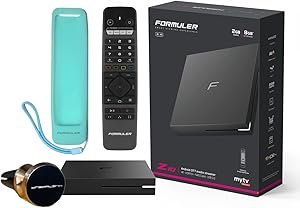
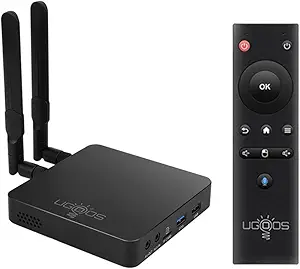
It is entirely the wrong purchase for someone who wants Netflix and Disney+ on a small box, where certification matters far more than format support. Those buyers should read the Kinhank G1, which claims Google and Netflix certification. Enthusiasts comparing similar hardware should look at the Ugoos AM6B Plus and the Formuler Z10, while anyone specifying commercial signage playback should read the BrightSign XT244. The full range sits in the streaming media players category.