

Description
What the Mounting Dream MD2296 is
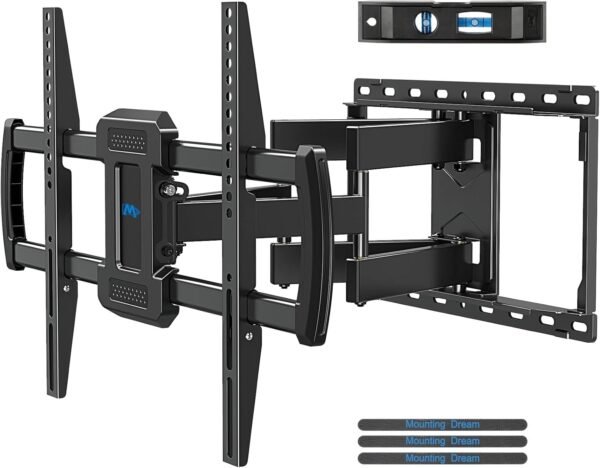
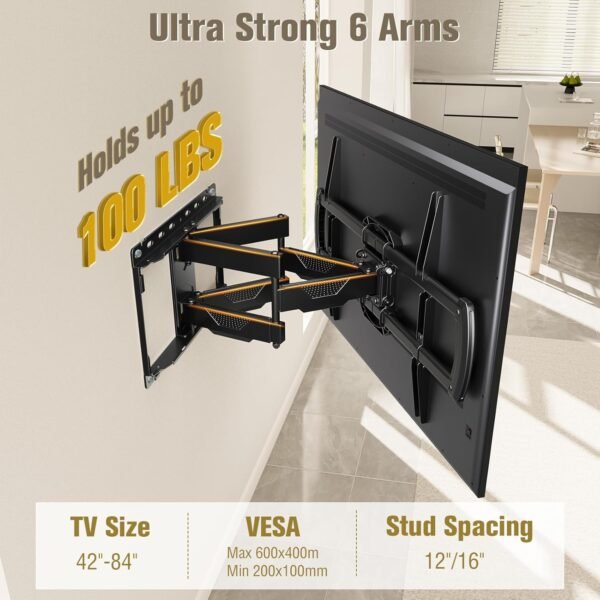
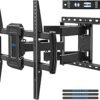
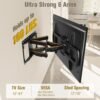
The MD2296 is a full motion television wall mount with dual articulating arms. It is UL Listed, rated for screens from 42 to 84 inches and loads up to 100 pounds, and takes a maximum VESA pattern of 600 by 400 mm, which the listing also gives as 24 by 16 inches. It fits 16 inch wood stud spacing. The mount weighs 13.46 pounds and is made in Vietnam.
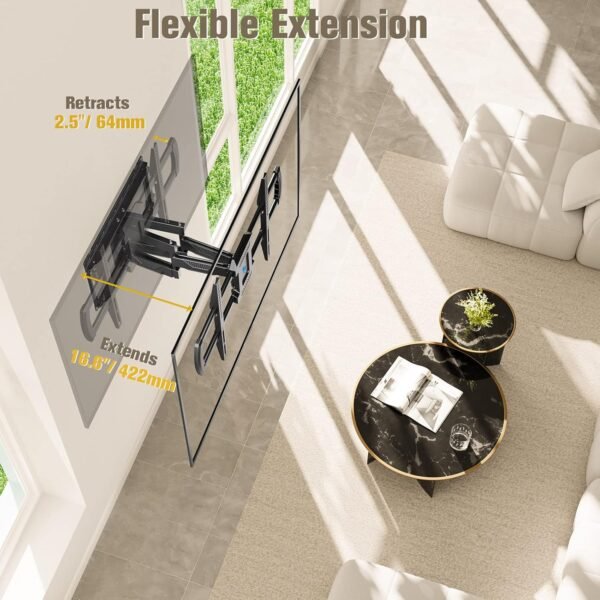
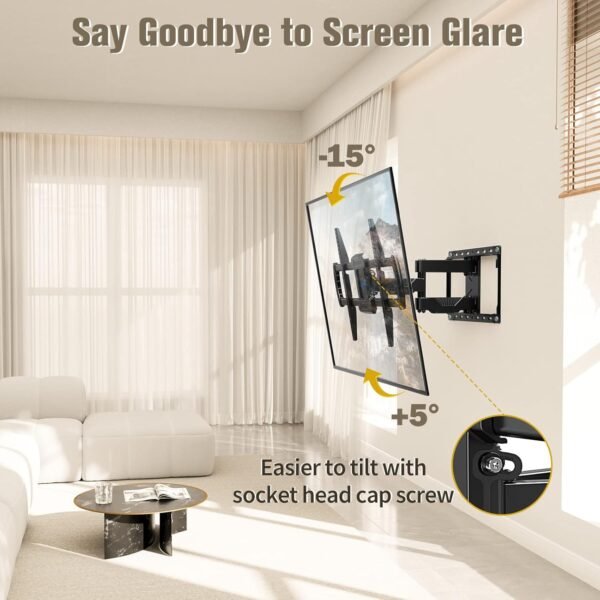
Full motion means the screen can be pulled away from the wall, swiveled to face a different part of the room and tilted. The arm assembly consists of six articulating sections that extend up to 16.6 inches from the wall and retract to 2.5 inches. Adjustment ranges are 5 degrees of upward tilt, 15 degrees of downward tilt, 45 degrees of swivel and 4 degrees of leveling correction.
The box includes clear instructions, a paper drilling template, a level, pre labeled packages of screws and spacers, and velcro strips for cable management.
Check three numbers before you buy
Wall mounts fail on compatibility rather than quality, and three specifications decide whether this one fits a given television.
The first is weight. The mount is rated at 100 pounds. That covers most televisions up to around 75 inches comfortably, but many 80 inch and larger sets exceed it. The screen size range in the product name goes to 84 inches, and screen size and weight do not track each other reliably. Check the actual weight of the television, not its diagonal.
The second is the VESA pattern, and this is where most mismatches happen. The maximum here is 600 by 400 mm. A substantial number of televisions at 75 inches and above use 800 by 400 mm, which this mount cannot take. Anyone shopping for a large screen such as the Hisense 75U7N should confirm the set’s VESA pattern against this limit before ordering, particularly since many television listings, including that one, do not publish it.
The third is stud spacing. This mount fits 16 inch wood studs and Mounting Dream states in capitals, twice, that its mounts are not for drywall installation. That is worth taking seriously: a 100 pound television on an arm extended 16.6 inches from the wall generates substantial leverage, and drywall anchors are not adequate for it. Concrete anchors are available from Mounting Dream’s customer service in a 10 by 50 mm size, but a plaster or drywall only wall with no accessible stud is not a suitable location.
The swivel range, honestly
Forty five degrees of swivel is modest for a mount described as full motion. Many competing mounts offer 90 degrees or more, and the difference matters in a room where the television is watched from the side or from an adjoining kitchen. Extended fully, the arms allow the screen to move well away from the wall, which broadens the effective range, but the rotation itself is limited.
The 15 degrees of downward tilt is generous and it is the more useful of the two tilt directions, since televisions are usually mounted above eye level. Four degrees of post installation leveling is a genuinely practical inclusion, because studs are rarely exactly plumb and correcting a slight tilt without removing the mount saves considerable frustration.
Retracting to 2.5 inches is good for a dual arm mount, though it is not the near flush profile a fixed mount achieves. Anyone who never intends to move the screen is better served by a fixed bracket, which sits closer to the wall and costs less.
Installation in practice
What is in the box tells you how seriously the installation has been thought about. A paper drilling template means the holes can be marked without holding the bracket against the wall. A level is included rather than assumed. The screws and spacers arrive in pre labeled packages, which matters because television mounting hardware comes in several thread sizes and picking the wrong one can damage the threaded inserts in the back of a screen.
Spacers are the part people overlook. Many televisions have a curved or recessed back, or ports that sit close to the mounting holes, and spacers set the bracket arms far enough out to clear them. Getting that wrong is how a screen ends up resting against its own cable connectors. The EVA pad on the wall plate is a smaller touch, cushioning the plate against the wall surface so it does not mark paint or rock on an uneven finish.
Highlights
- UL Listed, rated for 42 to 84 inch screens up to 100 pounds.
- Dual arms with six articulating sections, extending 16.6 inches and retracting to 2.5 inches.
- Tilt 5 degrees up and 15 degrees down, swivel 45 degrees, level adjust 4 degrees.
- Maximum VESA 600 by 400 mm, fits 16 inch wood stud spacing.
- Paper template, level and pre labeled hardware packages included.
- EVA padding on the wall plate and robotic welded construction.
- Velcro cable management strips supplied.
- United States based customer support for pre purchase and installation questions.
Things To Consider
- Not for drywall installation. Mounting Dream states this explicitly and it should not be worked around.
- Maximum VESA of 600 by 400 mm rules out many televisions of 75 inches and above.
- The 100 pound limit is below the weight of some sets within the 84 inch size range quoted.
- Forty five degrees of swivel is limited compared with many full motion mounts.
- Concrete anchors are not in the box and must be requested from customer service.
- The published 11.75 by 11.44 by 3 inch dimensions are the carton, not the installed mount.
- A fully extended arm carrying a heavy screen puts significant load on the fixings. Stud location and fastener depth matter more than the mount itself.
- Two people are needed to lift a large screen onto the bracket safely.
Who it suits
This is a sound choice for a television between 42 and around 75 inches, weighing under 100 pounds, with a VESA pattern of 600 by 400 mm or smaller, going onto a wall with accessible 16 inch wood studs. Within those limits it offers a lot of adjustment, the included template and level make installation manageable for one competent person plus a helper for the lift, and the 4 degree leveling correction is a detail cheaper mounts leave out.
It is not the right mount for the largest televisions, where both the weight limit and the VESA ceiling become problems. Anyone specifying a mount for a very large panel such as the TCL 98 inch QLED or the Samsung 98 inch Neo QLED needs a heavier duty bracket entirely. Buyers matching a mount to a mid size set should read across the LED and LCD TVs category, including panels such as the LG OLED C1, and confirm the VESA pattern before ordering. The mount category itself is TV wall and ceiling mounts.