

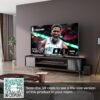
Description
What the Hisense 75U7N is
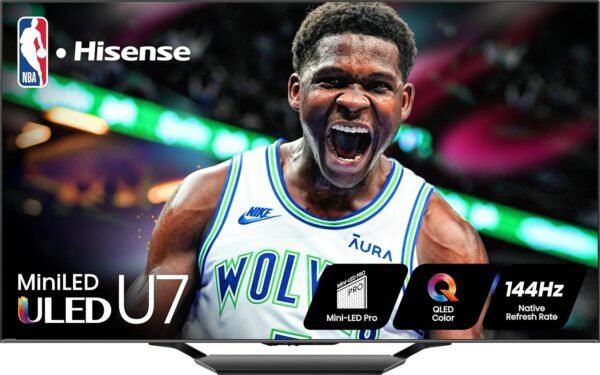
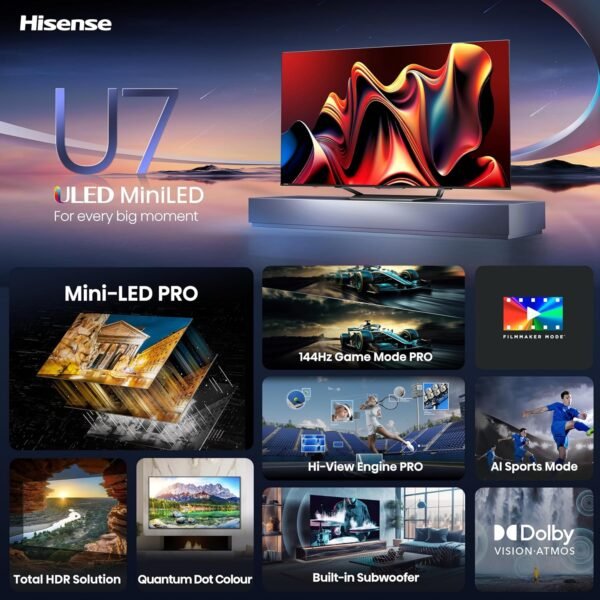
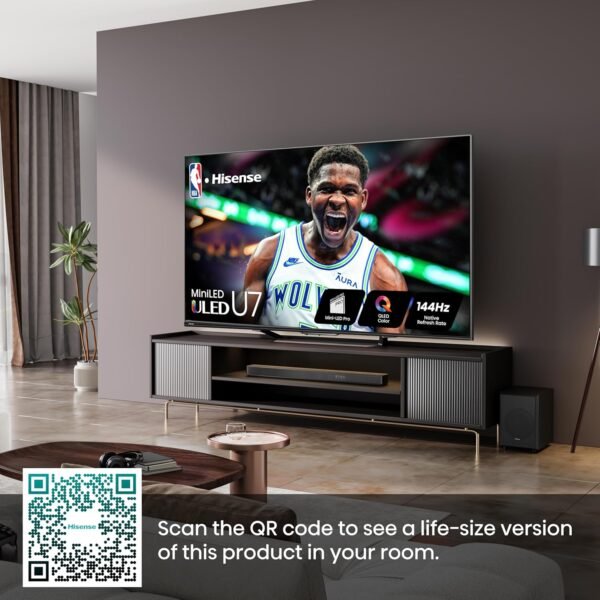
The 75U7N is a 75 inch class television from Hisense’s U7 series. Getting the panel technology right matters here, because the listing uses three different names for it. The panel is an LCD. Behind it is a Mini-LED backlight, meaning the backlight is made of a large number of very small LEDs arranged in zones that can be dimmed independently. In front of it is a quantum dot layer, which is what Hisense and other manufacturers label QLED. Hisense adds its own ULED branding on top of all that.
None of those names change what the display is. It is a backlit LCD, not a self emissive panel. An OLED television such as the LG OLED C1 switches individual pixels off and works on a completely different principle. The advantage of Mini-LED against OLED is peak brightness in a bright room; the advantage of OLED is absolute black and no blooming around bright objects. Anyone weighing the two should be clear that QLED and OLED are not variations of the same technology.
Native resolution is 4K UHD at 3840 by 2160. The panel’s native refresh rate is 144Hz, and this is one of the rare cases where a listing gives a real refresh figure rather than a marketing motion number: Hisense states a variable refresh range of 48Hz to 144Hz, which only makes sense if the panel itself runs to 144Hz.
Backlight, brightness and local dimming
Full array local dimming is the feature that makes a Mini-LED backlight worth having. The backlight is divided into zones and the set dims the zones behind dark parts of the image while driving the zones behind bright parts harder. That widens the effective contrast well beyond what an edge lit LCD can manage. Hisense does not publish a zone count for this model anywhere in the listing, and zone count is the number that actually determines how well local dimming performs, so that is a meaningful gap.
Hisense states peak brightness reaching up to 1500 nits. That is the manufacturer’s figure, given without a test window size or a measurement standard, and peak brightness numbers vary enormously depending on how much of the screen is lit. Treat it as a claim about capability in a small highlight rather than a level the whole panel sustains.
The quantum dot layer is what Hisense refers to when it claims over a billion individual shades. Quantum dots convert backlight into narrower, purer red and green output, which widens the color gamut. That is a real mechanism. The billion shades figure is a bit depth calculation rather than a measured gamut coverage, and the listing gives no DCI-P3 percentage.
Gaming, HDR and sound
The gaming specification is the strongest part of this set. A 144Hz native panel, variable refresh rate from 48Hz to 144Hz, AMD FreeSync Premium Pro and a Game Bar overlay that can be adjusted from the TV remote rather than the controller. Hisense also names Low Latency MEMC. For a console or a PC that can drive high frame rates, this is a genuinely capable display, and it is the reason to choose the U7 over a cheaper series.
On HDR, the listing confirms Dolby Vision IQ and Dolby Atmos. Dolby Vision IQ adds ambient light adaptation to standard Dolby Vision. IMAX Enhanced certification and Filmmaker Mode are both listed. The listing does not mention HDR10+ and does not state HDR10 explicitly, so those should not be assumed from this data even though HDR10 support is near universal on 4K sets.
Audio is a 2.1 channel arrangement: three speakers with a built-in subwoofer and 40 watts of maximum power, with Dolby Atmos decoding. Forty watts across a 75 inch television is modest, and a set at this size and specification is usually paired with a soundbar.
Connectivity includes Wi-Fi 6E and Google TV as the platform. The listing does not state the HDMI port count, does not identify which ports carry HDMI 2.1 bandwidth and does not list the USB or optical outputs. For a set sold on 144Hz gaming, the absence of a documented HDMI 2.1 port count is the most frustrating gap in the listing, because that is what determines how many high frame rate sources can be connected at once.
Highlights
- 75 inch class LCD with Mini-LED backlight, full array local dimming and a quantum dot layer.
- Native 4K UHD resolution at 3840 by 2160.
- Native 144Hz refresh rate with variable refresh from 48Hz to 144Hz and AMD FreeSync Premium Pro.
- Dolby Vision IQ and Dolby Atmos, plus IMAX Enhanced certification and Filmmaker Mode.
- Hi-View Engine Pro processing with dynamic tone mapping.
- 2.1 channel audio, three speakers with a built-in subwoofer, 40 watts maximum.
- Wi-Fi 6E and Google TV, with Alexa compatibility listed.
- Two year warranty on ULED sets, which Hisense notes is double its standard term.
Things To Consider
- The local dimming zone count is not published. Without it there is no way to judge how finely the backlight can be controlled or how much blooming to expect.
- The 1500 nit peak brightness figure is a manufacturer claim with no stated measurement conditions.
- HDMI port count and HDMI 2.1 bandwidth allocation are absent from the listing, which matters on a 144Hz gaming set.
- HDR10+ is not mentioned. Only Dolby Vision IQ is confirmed among the dynamic HDR formats.
- This is a backlit LCD. It cannot produce the absolute black of an OLED panel, and bright objects on dark backgrounds will show some halo.
- 40 watts of built-in audio is modest for a 75 inch set.
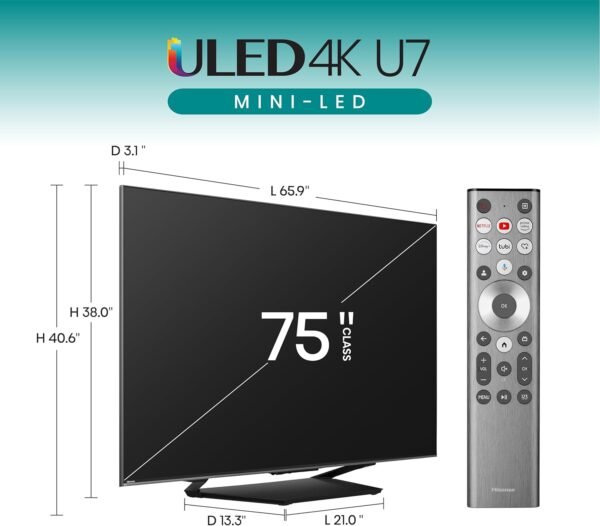
- The Amazon record for this product carries no attribute table at all, so no dimensions, no weight, no stand width and no VESA pattern are published. Anyone buying a wall mount or measuring a media unit will have to source those separately.
- A 75 inch television is a two person lift and needs a substantial wall or stand.
Who it suits
This set is aimed at someone who wants a large, bright screen for a room with daylight in it, and who games on hardware capable of high frame rates. The combination of a native 144Hz panel, a wide variable refresh window and a Mini-LED backlight is a strong package, and the two year warranty is better than most.
It is not the right choice for a dedicated dark room where absolute black level is the priority, where an OLED such as the Sony BRAVIA XR A80L answers a different question. Buyers who want the same series in a different size should compare the Hisense 75U7K and the Hisense 85U6N, or step down to the 65 inch U6 series if the room cannot take 75 inches. The rest of the range sits in the QLED TVs category, and anyone wall mounting a set this size should read the Mounting Dream MD2296 review first.