
Description
Roku Plus Series 65R6A5R 65-Inch 4K QLED Smart TV: what it is
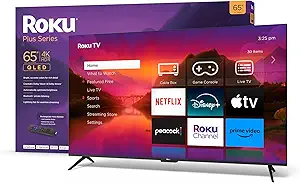
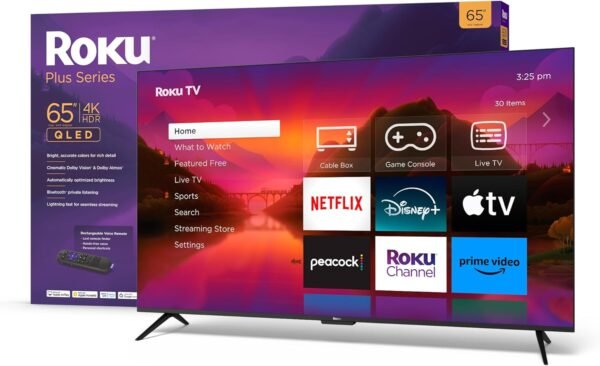
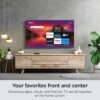
The 65R6A5R is a 65-inch television from Roku’s own Plus Series, first listed in January 2024. Roku spent years supplying its operating system to other manufacturers before building televisions under its own name, and the Plus Series is the upper tier of that own brand range. The listing records a 65-inch standing screen display size, a 16:9 aspect ratio, a weight of 49.6 pounds, product dimensions of 13.1 by 57 by 35.9 inches, and a special features list naming a bezel-less design, local dimming, HDR10+, Dolby Vision and an ambient light sensor.
Sixty five inches is the mainstream living room size. It wants roughly eight to twelve feet of viewing distance and a wall or media unit at least 58 inches wide. A full motion mount such as the Mounting Dream MD2296 is rated for screen sizes and weights in this range. The 13.1 inch depth in the dimensions is the stand footprint, not the panel, so a media unit needs to be deep enough to take the feet.
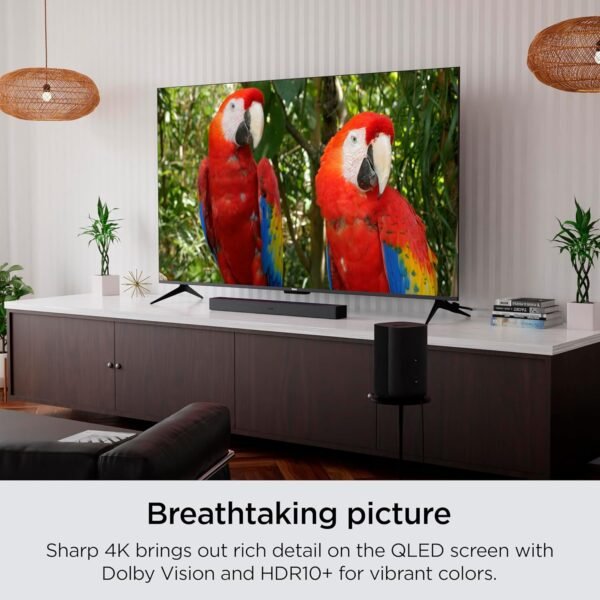
Picture: local dimming plus both dynamic HDR formats
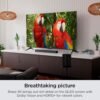
Three items in the specification list do real work together. Local dimming means the backlight is divided into zones that brighten and darken with the picture rather than running at one level across the whole panel, which is how an LCD improves its contrast. Dolby Vision and HDR10+ are the two competing dynamic metadata HDR formats, and having both is genuinely useful, because different streaming services back different formats. A set that supports only one will fall back to basic HDR10 on services that use the other.
The quantum dot layer is what puts the QLED label on this set. It widens the range of colors the panel can produce. It is a color technology and not a contrast technology, and it does not make the set an OLED. A self emissive panel such as the LG OLED C1 remains a different category on black level.
What the listing does not publish is the local dimming zone count, a peak brightness figure in nits, or the native refresh rate. All three matter, and the refresh rate matters most for anyone buying with a console in mind. Confirm it in plain hertz with Roku rather than reading any motion feature name as a hardware specification.
The ambient light sensor
An ambient light sensor adjusts the backlight to the light in the room, brightening in daylight and dimming at night. On a set that will be watched both at three in the afternoon and at eleven at night, it removes a manual adjustment most people never make, and it reduces the eye strain of an over bright panel in a dark room. It is a small feature that gets used every day.
The Roku platform, which is the actual selling point
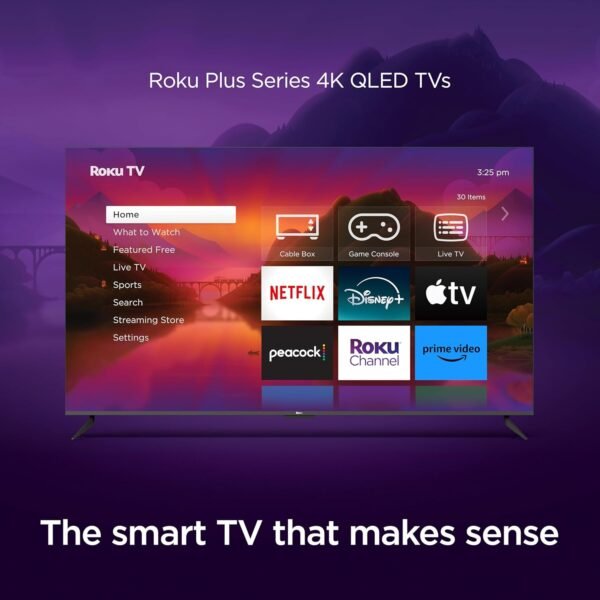
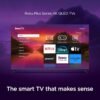
Roku’s operating system is the reason to buy a Roku television rather than someone else’s. It is deliberately simple, it treats every streaming service as an equal tile rather than promoting one, it runs on modest hardware without feeling slow, and Roku has a long record of keeping older devices updated. The same platform is available separately on a Roku streaming player for anyone keeping an existing set. For a household that finds Google TV or Tizen cluttered, that simplicity is worth real money.
The listing records a lithium ion battery included with the remote, which is consistent with Roku’s rechargeable voice remote rather than a disposable battery unit, although the exact remote model is not named in the specification block. Anyone who specifically wants the rechargeable remote with the lost remote finder should confirm which remote is in the carton.
The manufacturer description is short and unusually modest: Roku describes the Plus Series as designed to give viewers a premium entertainment experience at a strong value. There is no specification detail in it at all, which is why the attribute table is doing the work in this review.
Highlights
- 65-inch 4K quantum dot LCD panel with local dimming named in the listing.
- Both Dolby Vision and HDR10+ supported, which covers the dynamic HDR formats used by different streaming services.
- Ambient light sensor that adapts backlight output to the room.
- The Roku operating system, which is the simplest and most service neutral of the major smart platforms.
- Bezel-less design and a 49.6 pound weight, a manageable two person wall mount.
- 865 customer ratings on record averaging 4.4 stars, a solid feedback profile for a set listed in 2024.
Things To Consider
The unpublished specifications are the main gap: no dimming zone count, no brightness figure, no native refresh rate. Local dimming with an unstated zone count could mean anything from a handful of zones to a genuinely fine grained backlight, and the difference is visible.
The wattage field records the number 273 with no unit attached. Read in context it is almost certainly 273 watts of power consumption, which is plausible for a 65-inch panel, but a specification field with a bare number and no unit is exactly the sort of listing artifact worth treating with caution. No voltage field is recorded at all, though a set sold for the United States market runs on the standard 120 volt supply.
Roku’s platform simplicity is a strength for most households and a limitation for some. There is no equivalent of the deeper picture calibration menus that Sony, LG and Samsung offer, and enthusiasts who want fine control over the image will find it shallow.
Built in audio in a thin 65-inch cabinet is adequate rather than good. The listing does not publish an audio output figure, and a soundbar remains the single most effective upgrade.
Who should buy it, and who should not
This suits a household that wants a large, current 4K set with both dynamic HDR formats and does not want to fight the software. If several people of different ages and technical confidence share the remote, the Roku interface is genuinely the least frustrating option in this catalog.
Skip it if picture adjustment depth matters, or if a confirmed high refresh panel is required for gaming, in which case a set with a published native figure such as the Hisense 75U7K is the safer buy. Skip it for a dark theater room where OLED is the right technology and the OLED TVs category is the place to look. And anyone who mostly wants a display that disappears into the decor should look at Samsung’s The Frame instead. Comparable options sit in the QLED TVs category.