

Description
What the Hisense 65U6K is
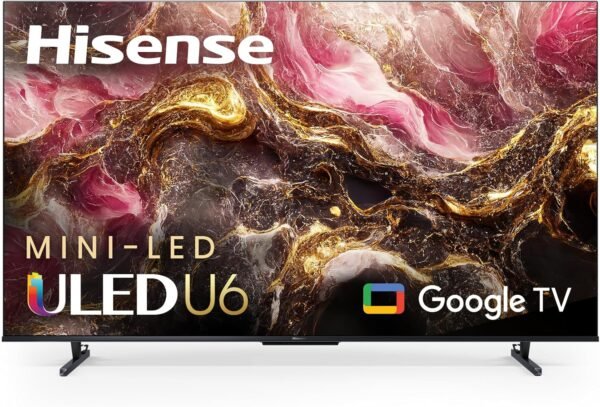
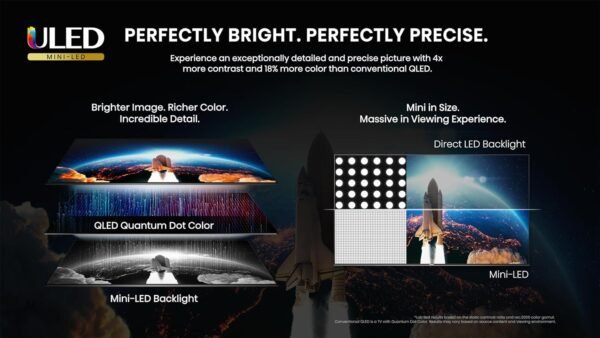
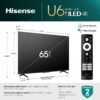
The 65U6K is a 65 inch class television from Hisense’s U6 series, which sits below the U7 in the range. The panel is an LCD with a Mini-LED backlight behind it and a quantum dot layer in front of it. Hisense applies three names to that arrangement, Mini-LED, ULED and QLED, and none of them change what it is: a backlit LCD, not a self emissive panel like an OLED.
Native resolution is 4K UHD. Hisense states that this generation adds Mini-LED and over four times the local dimming zones compared with its predecessor. Note the form of that claim: it is a multiple against an earlier model, not an absolute zone count, and the actual number of dimming zones is not published anywhere. Zone count is what determines how precisely the backlight can be controlled, so its absence is the most significant gap in the listing.
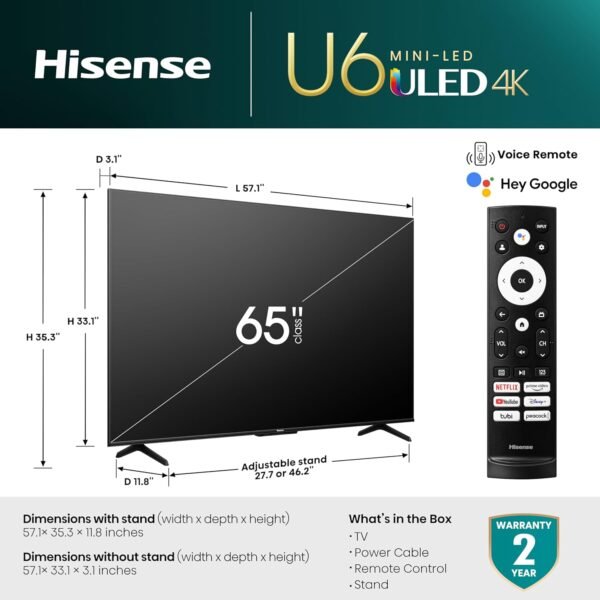
Published figures are a weight of 27.5 kilograms, dimensions of 3.1 by 57.1 by 33.1 inches, an audio output of 20 watts, a total power figure of 250 watts and a 120 volt supply. The remote takes two AAA batteries, which are included.
The refresh rate, stated properly
The product name includes the phrase 240 Motion Rate. That number is not a refresh rate and it should not be read as one.
Motion rate figures are marketing constructions that combine the panel’s actual refresh rate with backlight scanning and frame interpolation processing. They vary between manufacturers and are not comparable across brands. The panel’s native refresh rate is the number that matters, because it sets the ceiling on how many distinct frames per second the screen can display.
Hisense states the real figure elsewhere in its own description: Game Mode Plus offers a variable refresh rate at 60Hz. A variable refresh rate cannot exceed the panel’s native rate, so this is a 60Hz panel. That is entirely normal at this level and it is genuinely useful for console gaming at 60 frames per second, where VRR eliminates tearing. It is not a high frame rate gaming display, and anyone wanting 120Hz or above should look at the Hisense 75U7N, which publishes a native 144Hz panel with a 48 to 144Hz variable range.
HDR, dimming and picture
The HDR format support here is broad. Hisense lists Dolby Vision IQ and HDR10+, which are the two competing dynamic metadata standards, and Dolby Atmos for audio. Very few sets support both dynamic HDR formats, and having them removes any question about which streaming service will look right.
Dolby Vision IQ adds ambient light sensing to standard Dolby Vision, adjusting tone mapping to the light in the room rather than assuming a dark one. In a normally lit living room that is a real benefit rather than a specification line.
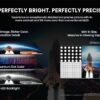
Full array local dimming is the feature that makes the Mini-LED backlight worthwhile, dimming the zones behind dark parts of the image while driving the bright zones harder. Quantum dots widen the color gamut by converting backlight into purer red and green. Both are genuine mechanisms. Without a published zone count, a peak brightness figure or a color gamut percentage, there is no way to say how far they go on this particular model, and no figure will be invented here.
The platform is Google TV with hands free voice control, meaning the set responds without a button press on the remote. Alexa compatibility is also listed. Hisense describes a bezel-less design and a wide color enhancer among the special features.
What Mini-LED buys at this level
Mini-LED describes the size of the individual backlight elements rather than the panel itself. Smaller LEDs mean more of them can be fitted behind the screen, and more of them means the backlight can be divided into more independently controlled zones. The effect is a picture that holds a bright object against a dark background without lighting up the whole area around it.
The benefit scales with zone count, which is why the missing number matters. A set with a few dozen zones behaves quite differently from one with several hundred, and both can be marketed as Mini-LED with full array local dimming. Hisense states four times the previous generation without saying what the previous generation had, so the multiple communicates improvement without communicating a level. What can be said is that any zone based dimming is a meaningful step above an edge lit panel with no dimming at all.
Highlights
- 65 inch class LCD with Mini-LED backlight, full array local dimming and quantum dot color.
- Native 4K resolution with a 60Hz panel and variable refresh rate in Game Mode Plus.
- Dolby Vision IQ and HDR10+, an unusually complete HDR format set.
- Dolby Atmos audio decoding with 20 watts of output.
- Google TV with hands free voice control and Alexa compatibility.
- Bezel-less design.
- Four times the local dimming zones of the previous generation, per Hisense.
- Runs on a standard 120 volt supply, listed at 250 watts.
Things To Consider
- The 240 Motion Rate figure in the product name is not a refresh rate. The panel is 60Hz.
- The local dimming zone count is not published, only a multiple against the previous generation.
- No peak brightness, contrast ratio or color gamut coverage figure appears anywhere.
- No HDMI port count, no HDMI version and no eARC statement.
- The weight is given in kilograms on a listing otherwise using inches and pounds.
- Only carton style dimensions are given, with no stand width or VESA pattern.
- Twenty watts of audio is modest for a 65 inch set.
- This is a backlit LCD and cannot reach the absolute black of an OLED panel.
Who it suits
The U6K is aimed at someone who wants Mini-LED and dual dynamic HDR support at the accessible end of the market, watches in a room with some light in it, and games on a console at 60 frames per second. On format support in particular it punches well above its position in the range.
It is not the set for high frame rate PC gaming, or for a buyer who needs published performance figures. Those looking at the same technology in a larger size should read the Hisense 85U6N, and those wanting a higher tier panel should compare the Hisense 75U7K or the VIZIO M65Q6-L4 in the QLED TVs category. Anyone wall mounting a 65 inch set should check the VESA pattern against the Mounting Dream MD2296 before ordering.