Description
What the Wolverine TransMedia is
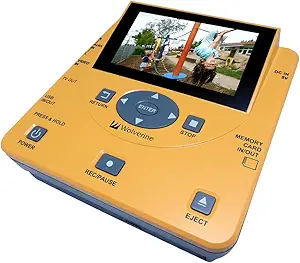
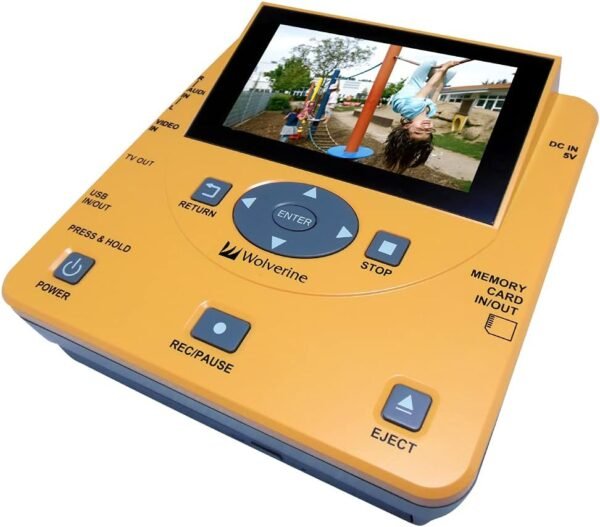
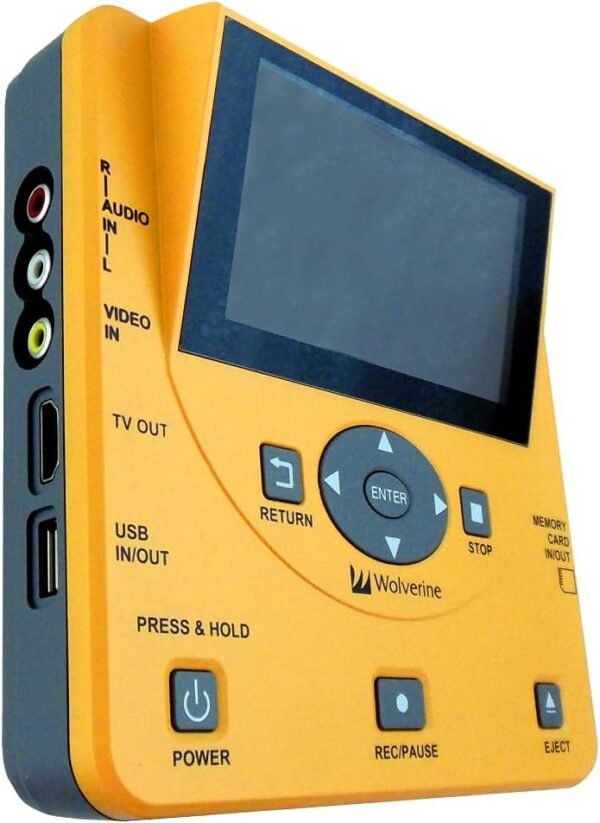
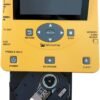
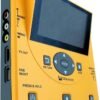
The TransMedia is a standalone box for converting analog home video into digital files. Its purpose is narrow and useful: connect a VCR, a camcorder or another analog source to the RCA inputs, press record, and the box captures the signal to a file without a computer, a capture card or any software.
That is the whole argument for a device like this. Capturing analog video on a computer means a capture dongle, drivers, software that may or may not still be supported, and a machine that has to keep up in real time. A dedicated box removes all of it. The unit has a 4.3 inch color LCD on the front so the capture can be monitored as it happens.
Wolverine Data is the manufacturer, the model name is TransMedia, the country of origin is China, and the listing dates first availability to August 2021. It ranks 302nd in Amazon’s Video Converters category.
Inputs, outputs and destinations
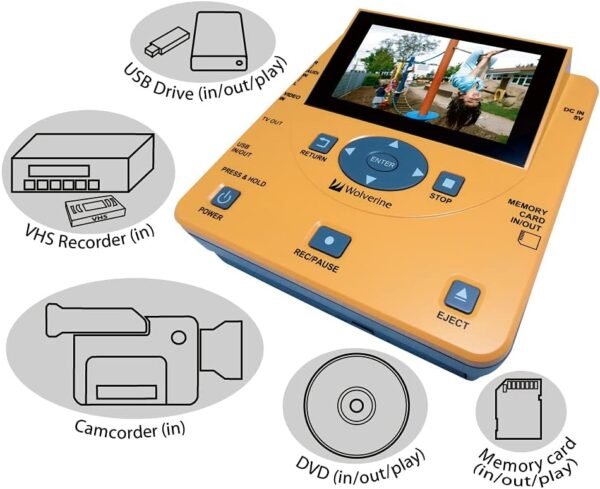
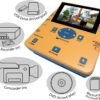
The recording paths Wolverine lists are specific. Analog AV input from a camcorder or VCR can go to a USB flash drive or hard drive over USB 2.0, to an SD card of up to 32 GB, or directly to a recordable DVD. Separately, DVDs or CDs already in hand can be copied to an SD card or a USB drive, and music CDs can be ripped to MP3 or WAV files.
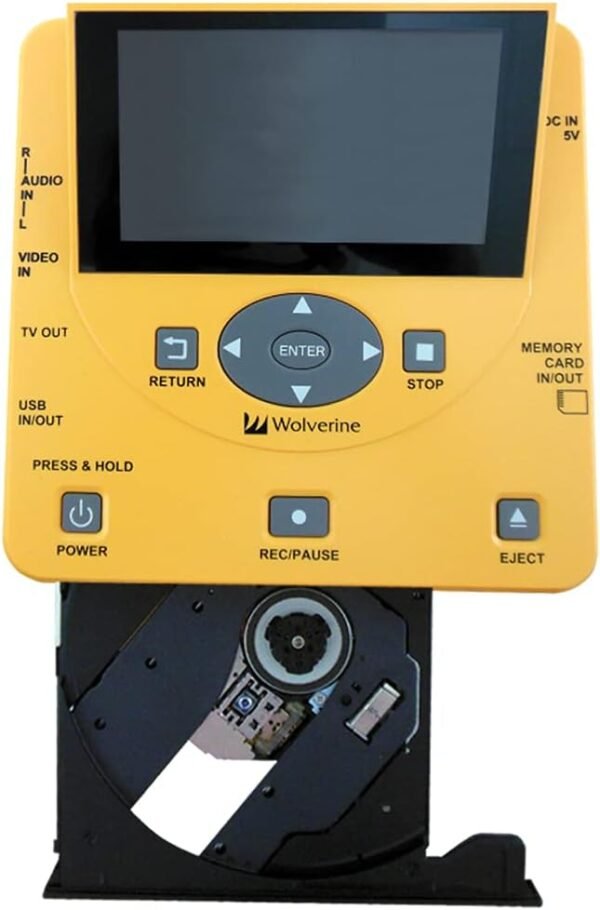
The port list is AV RCA input, a DVD drive that reads, writes and plays, an SD card slot that reads, writes and plays, a USB port that reads, writes and plays, and an HDMI output. HDMI out means the box can be connected to a television to play back what it has captured, which makes it a viewer as well as a recorder.
Two constraints in that list are worth pulling out. The SD card ceiling of 32 GB is the FAT32 era limit and it caps a single capture session, since video files are large. USB 2.0 is slow by current standards, which matters for transferring finished files off the device rather than for the capture itself, since analog video does not need much bandwidth.
What the listing does not tell you
This listing omits the specifications that determine whether the output is usable. There is no capture file format, no container, no codec, no bitrate, no frame rate and no output resolution. For a device whose entire job is producing video files, those are not minor gaps.
What can be said without guessing is where the ceiling sits. VHS and Hi8 are analog standard definition formats. A VHS recording carries roughly 240 lines of horizontal resolution, and no digitizer can add detail that was never on the tape. A converter of this kind preserves what is there; it does not improve it. Anyone expecting old family tapes to come out looking like modern video will be disappointed, and that is the tape’s limitation rather than the box’s.
The dimensions also conflict. Wolverine’s own feature text gives 6 inches wide by 6 long by 1.5 high, while the attribute table records 10 by 7 by 3 inches. The larger figure is almost certainly the shipping carton. The listed weight is 1.04 pounds.
Copyright, and copy protection
Two practical points that no product listing mentions.
First, commercial VHS tapes and DVDs frequently carry copy protection, and analog copy protection schemes deliberately disturb the video signal in ways that cause capture devices to produce unstable or unusable output. A device like this is designed for home recordings. It should not be assumed to work with commercially released material.
Second, converting content you do not own the rights to is a legal question rather than a technical one, and it varies by jurisdiction. Digitizing your own family recordings is the intended use and is uncontroversial. Copying purchased films or commercial music is a different matter.
Highlights
- Standalone operation with no computer, capture card or software required.
- Records analog AV from VCRs, camcorders and Hi8 sources.
- Output to USB flash drive, USB hard drive, SD card up to 32 GB or recordable DVD.
- Also copies DVDs and CDs to storage, and rips music CDs to MP3 or WAV.
- 4.3 inch color LCD for monitoring the capture.
- HDMI output for playback on a television.
- Light at 1.04 pounds and small enough to sit beside a VCR.
Things To Consider
- No capture format, codec, bitrate, frame rate or output resolution is published anywhere in the listing.
- SD cards are capped at 32 GB, which limits the length of a single capture session.
- USB 2.0 makes transferring finished files off the device slow.
- VHS and Hi8 are standard definition analog formats. Digitizing preserves the source, it does not improve it.
- Copy protection on commercial tapes and discs can prevent capture. This is a device for home recordings.
- Capture happens in real time. A two hour tape takes two hours.
- Dimensions conflict between the feature text and the attribute table.
- No source device is included. You still need a working VCR or camcorder, and those are increasingly hard to find in good condition.
Who it suits
This is a good buy for someone with a box of family tapes and no wish to become a video engineer. It does one job, it does it without a computer, and it writes to media most households already have. For preserving recordings that are physically degrading, the important thing is to capture them at all, and a device that removes every obstacle to starting is worth more than a technically superior route nobody gets around to using.
It is not for anyone who needs control over the encoding, who wants the highest possible quality from a valuable tape, or who is trying to copy commercial media. Buyers looking at signal conversion rather than archiving should read the HDMI to component converter and browse the video converters category. Anyone assembling an older home theater setup may also want the Dish Network VIP722K DVR, while those adding modern playback to the same television should look at the Roku 2 XD or the streaming media players category.
